0:00
0:00
Speed
 By Muhammad Haris · October 28, 2026 · Last updated: November 19, 2026 · 6 min read
Most e-commerce SEO advice is written by people who’ve never run a store. “Write better product descriptions” — as if you have time to hand-write 4,000 of them. “Build more links” — to what, exactly, a product page that changes price next week?
Real e-commerce SEO is an engineering discipline: category architecture, faceted navigation control, product schema at scale, and internal linking that funnels authority to the pages that make money. We’ve done this work on real stores with real revenue on the line. Here’s what actually moves the needle.
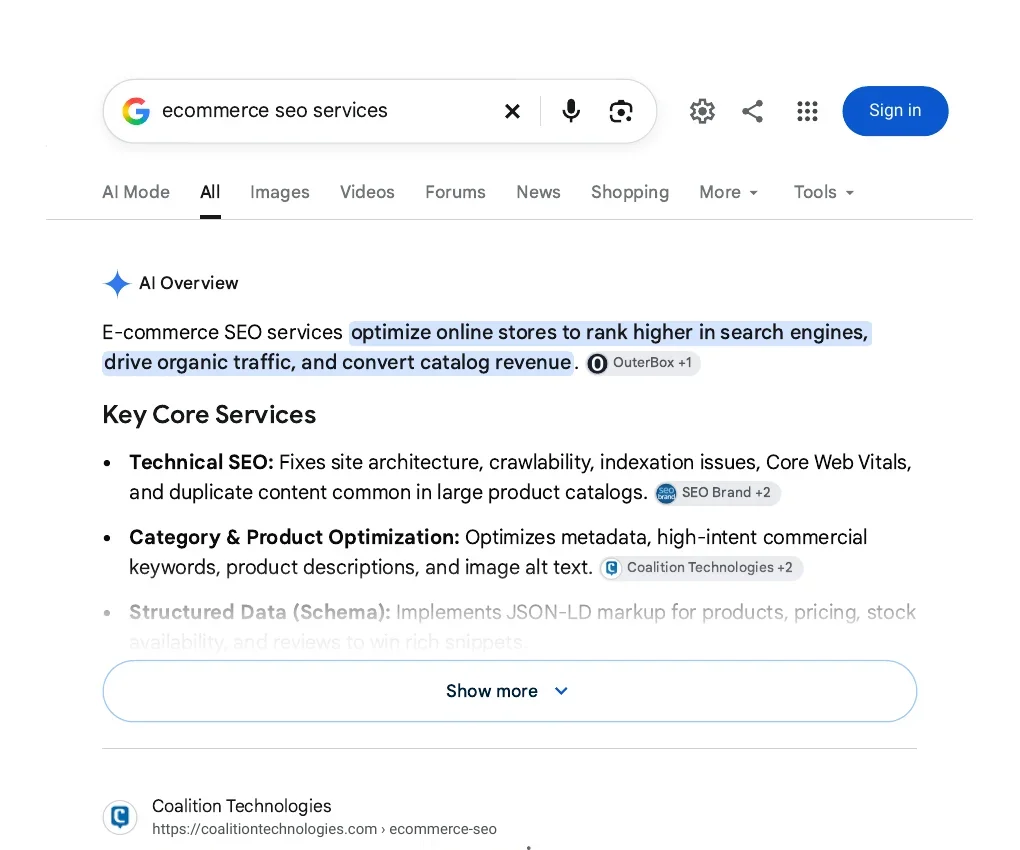
On an e-commerce site, architecture is strategy. The category tree decides which pages can rank, how authority flows, and whether Google can even find your products.
The rules that matter:
Categories target the head terms; products target the long tail. Your category page for “women’s running shoes” should be the ranking asset for that term — with real content, filters, and internal links. Individual product pages capture long-tail variants: brand + model + attribute. Stores that try to rank product pages for head terms lose to stores with strong category pages, every time.
Depth kills. Every click away from the homepage dilutes authority. Products buried four clicks deep in category > subcategory > filter > product rarely rank for anything competitive. Flatten ruthlessly: featured products linked from the homepage, best-sellers in category descriptions, related-product modules that actually pass link equity.
Faceted navigation is the silent killer. Color, size, price, brand filters generate thousands of near-duplicate URLs. Uncontrolled, they eat your crawl budget and create indexation bloat that drags the whole site down. The fix: canonical rules, strategic noindex on low-value facet combinations, and AJAX filtering that doesn’t generate URLs for every combination. This is unglamorous work that routinely produces the biggest ranking improvements on large catalogs.
Product schema is the highest-ROI structured data in e-commerce. Correct implementation gets you price, availability, ratings, and review counts directly in search results — which lifts click-through rates without changing your ranking.
What “correct” means: valid Product schema with offers, price, priceCurrency, and availability on every product page; AggregateRating only where you have genuine reviews (fake review markup is a manual-action waiting to happen); and regular validation, because one template change can break schema across the entire catalog.
We validate schema as part of every technical SEO engagement — it’s a five-minute check that protects a major traffic driver.
The content problem in e-commerce is scale. You cannot hand-write unique content for every product, and you don’t need to. What you need:
Category content that earns its place. 300-500 words of genuinely useful category copy — buying guidance, not keyword stuffing. “How to choose” content that answers the questions buyers actually ask. This content ranks, converts, and differentiates you from competitors with empty category pages.
Programmatic content with real data. Product descriptions generated from structured attributes (materials, dimensions, compatibility) beat both empty pages and spun content. The key: the underlying data must be real and specific. “100% organic cotton, 180 GSM, machine washable” is content. “High quality premium product” is noise.
A content hub for the consideration phase. Buying guides, comparison content, and use-case articles capture the research traffic that converts later. This is content strategy applied to commerce: cluster your guides around categories and link them down to the products.
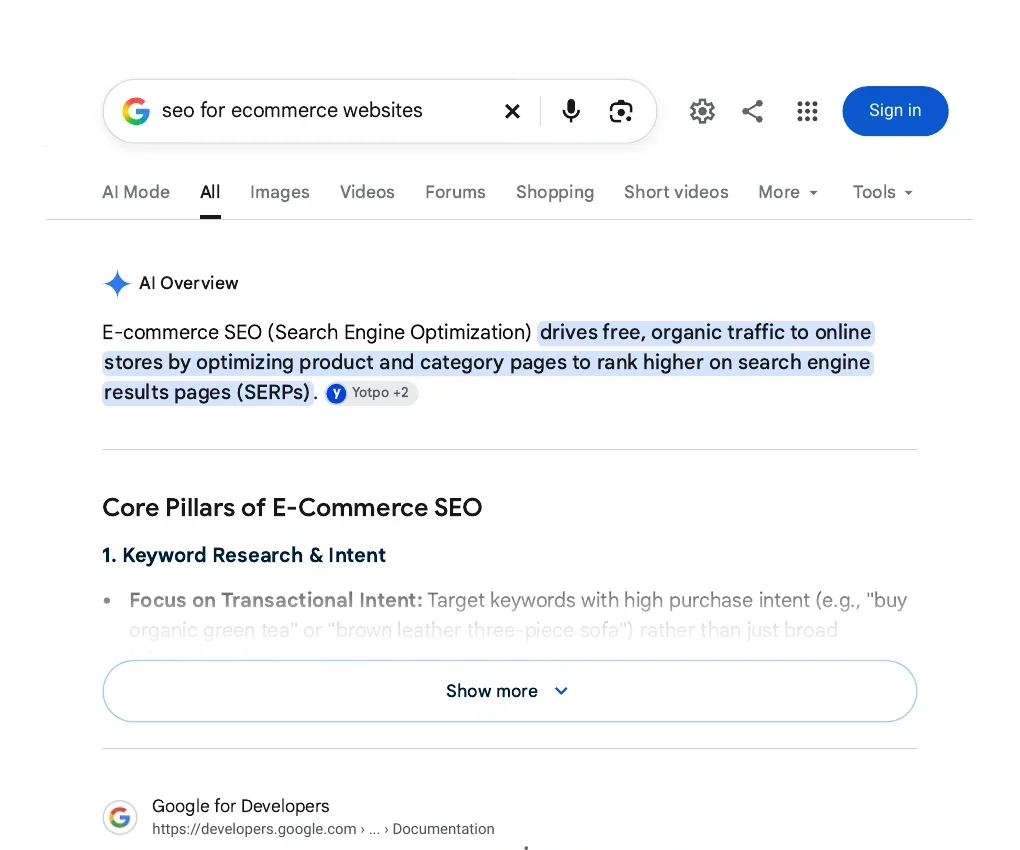
Enough theory. Two real engagements:
A women-led beauty brand came to us invisible — page three and beyond for everything that mattered. We rebuilt the category architecture, flattened product depth, fixed faceted navigation that had generated thousands of junk URLs, added product schema across the catalog, and built buying-guide content around their hero categories. In 6 months: organic orders grew steadily, organic traffic rose with them, and a growing set of keywords reached page one.
A women-led online store with a different problem — traffic existed, but it didn’t convert. We restructured the internal linking to push authority to best-sellers, fixed mobile speed issues, and cleaned up the checkout-adjacent UX signals. In 5 months: online sales grew steadily, organic traffic to product pages rose, and cart abandonment fell.
Same discipline, different diagnosis. That’s why e-commerce SEO starts with an audit, not a package.
E-commerce link building has one advantage: products are linkable assets. Digital PR around data (industry reports, surveys), gift guides (seasonal, evergreen), and resource content (buying guides journalists cite) earn links that service businesses can’t.
What doesn’t work: buying links to product pages (footprint risk on money pages), directory spam, and “link packages” that point 500 links at your homepage. E-commerce sites live and die on trust signals — a manual action on a store is a revenue event, not a ranking inconvenience.
Duplicate manufacturer descriptions. Using the supplier’s product copy verbatim means competing with every other store using the same text — plus the manufacturer. Rewrite or enrich; even structured attribute data beats duplicated prose.
Ignoring site speed on mobile. Most e-commerce traffic is mobile, and most e-commerce templates are heavy. Every second of load time costs conversion rate. Image optimization, lazy loading, and app-bloat audits are SEO work on a store.
Noindexing the wrong things. We’ve seen stores noindex entire categories during a “cleanup” and discover it months later. Every noindex decision on a revenue page needs a second pair of eyes.
How long does e-commerce SEO take?
Technical and architecture fixes move the needle in 6-12 weeks. Content and authority building takes 4-6 months. Our two store engagements above showed major results at 5 and 6 months — that’s the realistic band.
Should I focus on category pages or product pages?
Categories first — they’re the durable ranking assets. Product pages come and go; category architecture compounds. Get the categories right, then enrich top products.
Is Shopify or WooCommerce better for SEO?
Both can rank. WooCommerce gives more technical control (URL structure, schema, speed optimization); Shopify is simpler to run but constrains some technical levers. The platform matters less than the execution.
How many products do I need for SEO to be worth it?
It’s not about count — it’s about search demand for what you sell. A 50-product store in a high-demand niche beats a 5,000-product store nobody searches for. Check keyword demand before investing.
Can you work with our in-house team?
Yes — we often set strategy and handle the technical layer while in-house teams execute content. See our case studies for how these engagements are structured.
If your store has traffic that doesn’t convert, or products nobody finds, start with a free consultation — we’ll audit the architecture and tell you exactly where the revenue is leaking.

Muhammad Haris is the Founder of Onyx Growth Labs — an SEO specialist, content writer and SEO team lead. He writes the agency's guides on SEO, AI search optimisation, GEO and AEO, technical SEO, local SEO, Google Business Profile optimisation, link building and content strategy. Based in Abbottabad, Pakistan, he helps businesses worldwide get found on Google and in AI search answers.
A growing share of search no longer ends on a results page. People ask a question and receive a synthesized answer —…
Read articleSearch is changing. More and more people now get their answers directly from AI tools instead of clicking through a list of…
Read articleEveryone wants to be visible in AI answers. Almost nobody measures it. Businesses invest in "AI search optimization" and then judge success…
Read article


Leave a Reply