0:00
0:00
Speed
 By Muhammad Haris · October 28, 2026 · Last updated: November 19, 2026 · 6 min read
International SEO is where confident SEOs go to be humbled. Everything that works on a single-market site — crawl control, keyword targeting, link building — gets multiplied across languages, currencies, and Google’s country-specific indexes. And one tag, hreflang, causes more enterprise headaches than any other piece of markup on the web.
This guide covers the architecture decisions, the hreflang implementation done right, and the mistakes that cost companies entire markets.
Before hreflang, before translation, before anything — you choose how your international URLs are organized. Three options, each with real trade-offs:
ccTLDs (example.de, example.fr). Strongest geo-targeting signal; users trust local domains. But each ccTLD is a separate site in Google’s eyes — you’re building authority from zero in every market, and managing a dozen domains is operationally heavy. Right for: large companies with dedicated teams per market.
Subdirectories (example.com/de/, example.com/fr/). All authority consolidates on one domain; one CMS, one codebase, simpler management. Weaker geo signal than ccTLDs, but hreflang and Search Console geo-targeting close most of the gap. Right for: most businesses expanding internationally. This is our default recommendation.
Subdomains (de.example.com). The worst of both worlds in most cases — treated as separate entities like ccTLDs, without the user-trust benefit. There are edge cases (very different content per market), but for most companies, don’t.
Pick one structure and commit. Migrating between structures later is a multi-month project with real ranking risk.
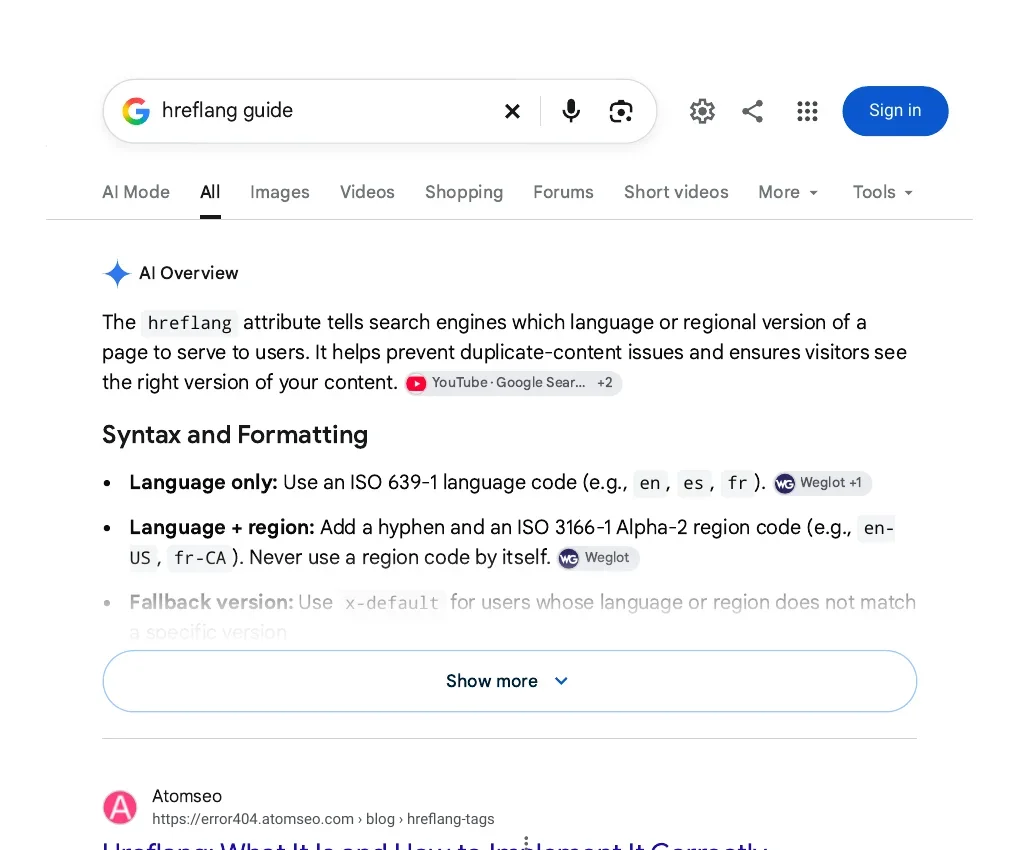
Hreflang is a signal — not a directive — that tells Google “these pages are alternate versions of each other for different languages or regions.” When it works, a searcher in Berlin sees your German page and a searcher in Paris sees your French page, instead of both seeing whichever version Google guessed.
The syntax looks simple:
en = English speakers anywhereen-GB = English speakers in the United Kingdomde = German speakers anywhereAnd every page in a hreflang cluster must reference every other page, including itself, plus an x-default for unmatched users. That’s where it breaks: on a 10-language site with 5,000 pages per language, that’s 50,000 pages each needing 11 correct hreflang tags. One CMS template bug and the whole cluster collapses.
Three implementation methods, in order of reliability:
1. HTTP headers. Best for non-HTML files (PDFs) and large sites. Set via server config; keeps HTML clean.
2. HTML head tags. The most common method. Each page’s head section carries the full set of alternate links. Works well when your CMS template generates them programmatically — dangerous when done manually.
3. XML sitemap. Hreflang annotations inside sitemaps. Clean separation from page templates, and easy to regenerate. Our preference for large sites: sitemap-based hreflang is auditable in one place instead of scattered across 50,000 page heads.
Whichever method you choose, the rules are absolute: hreflang tags must be bidirectional (if page A references page B, page B must reference page A), every URL must be absolute and return 200, and the x-default must exist. Google ignores broken hreflang clusters silently — no error, just the wrong page ranking in the wrong market.
Translating instead of localizing keywords. “Cheap flights” in American English and “cheap flights” in British English look identical but the SERPs differ — different competitors, different intent, different modifiers (“budget” vs “cheap”). Every market needs its own keyword research, not a translation of the head market’s list. This is local SEO thinking applied internationally.
One hreflang error breaking everything. We’ve audited sites where a single template change dropped the self-referencing tag across 8,000 pages. Google’s response: ignore the entire hreflang cluster. The fix took a week; the traffic loss took two months to recover. Hreflang needs automated monitoring, not annual audits.
Ignoring regional search engines. Google dominates most markets, but not all. Baidu in China, Naver in South Korea, Yandex in Russia — each has its own rules, and “Google best practices” don’t transfer. If you’re serious about those markets, you need market-specific expertise.
Currency, shipping, and legal content. International pages that show the wrong currency, unavailable shipping, or non-compliant legal terms don’t just convert poorly — they generate the negative user signals that drag rankings down. Localization is a conversion and UX project, not just an SEO one.
The practical workflow for keyword strategy across markets:
You can handle international SEO in-house if: you have two or three markets, one language family, and a developer who understands hreflang. The structure is manageable and the monitoring is simple.
You need specialist help when: you’re past five markets, running multiple languages, seeing wrong-region pages rank, or planning a URL structure migration. That’s technical SEO at enterprise complexity, and mistakes are expensive.
Do I need hreflang if I only target one language in multiple countries?
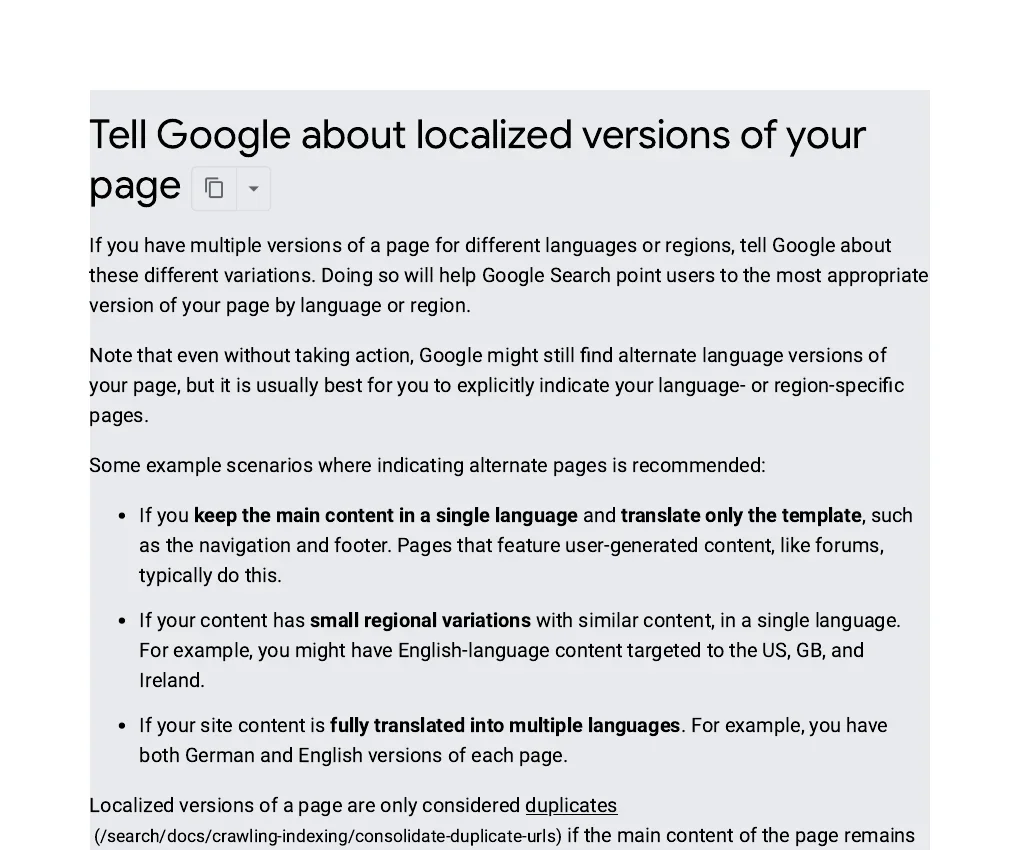
Yes — use regional codes (en-US, en-GB, en-AU). Without hreflang, Google picks one version to show everywhere, and it’s often the wrong one. Regional hreflang is the cheapest international win available.
How long does hreflang take to take effect?
Days to weeks for Google to process, assuming the implementation is correct. If nothing changes after a month, the implementation is broken — check bidirectionality first.
Should each market have its own Google Business Profile strategy?
For physical locations, absolutely — one profile per location, managed locally. That’s local SEO per market, and it’s often the highest-ROI international work for service businesses.
Can I use machine translation for international pages?
For user-facing commercial content, no — the quality gap is visible and it hurts conversions and rankings. Machine translation is acceptable for user-generated content and support docs with clear labeling. Your money pages deserve human localization.
What’s the biggest international SEO mistake you see?
Launching 10 markets with translated content, no hreflang, no local keyword research, and no local links — then wondering why only the home market ranks. International SEO is a per-market programme, not a translation project.
Expanding into new markets? Start with a free consultation — we’ll audit your current international setup (or plan it from scratch) and give you the honest architecture recommendation. Or reach us anytime through our contact page.

Muhammad Haris is the Founder of Onyx Growth Labs — an SEO specialist, content writer and SEO team lead. He writes the agency's guides on SEO, AI search optimisation, GEO and AEO, technical SEO, local SEO, Google Business Profile optimisation, link building and content strategy. Based in Abbottabad, Pakistan, he helps businesses worldwide get found on Google and in AI search answers.
A growing share of search no longer ends on a results page. People ask a question and receive a synthesized answer —…
Read articleSearch is changing. More and more people now get their answers directly from AI tools instead of clicking through a list of…
Read articleEveryone wants to be visible in AI answers. Almost nobody measures it. Businesses invest in "AI search optimization" and then judge success…
Read article


Leave a Reply