0:00
0:00
Speed
 By Muhammad Haris · September 23, 2026 · Last updated: November 19, 2026 · 8 min read
By Muhammad Haris
Muhammad Haris is an experienced SEO specialist and the founder of Onyx Growth Labs, with experience in technical SEO, content strategy, and link building.
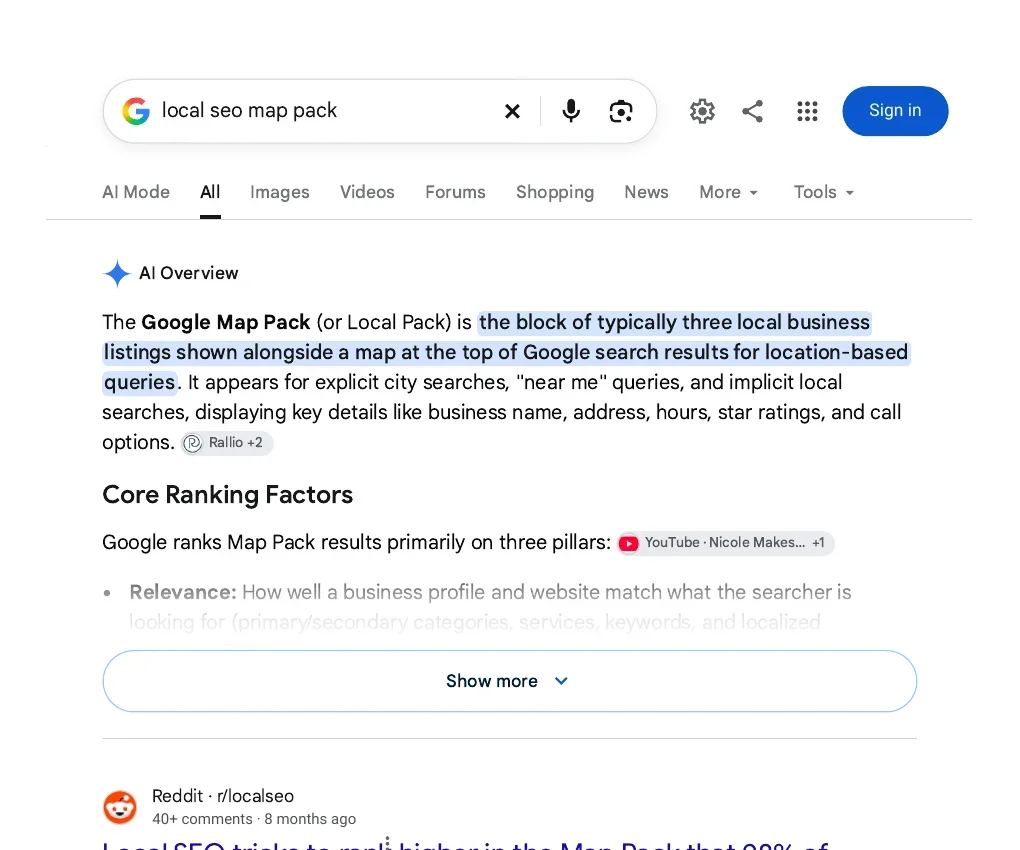
When someone searches for a service near them, Google shows a map with three businesses at the top. That is the map pack, and it captures a large share of clicks and calls. Local SEO is how you earn a place in it.
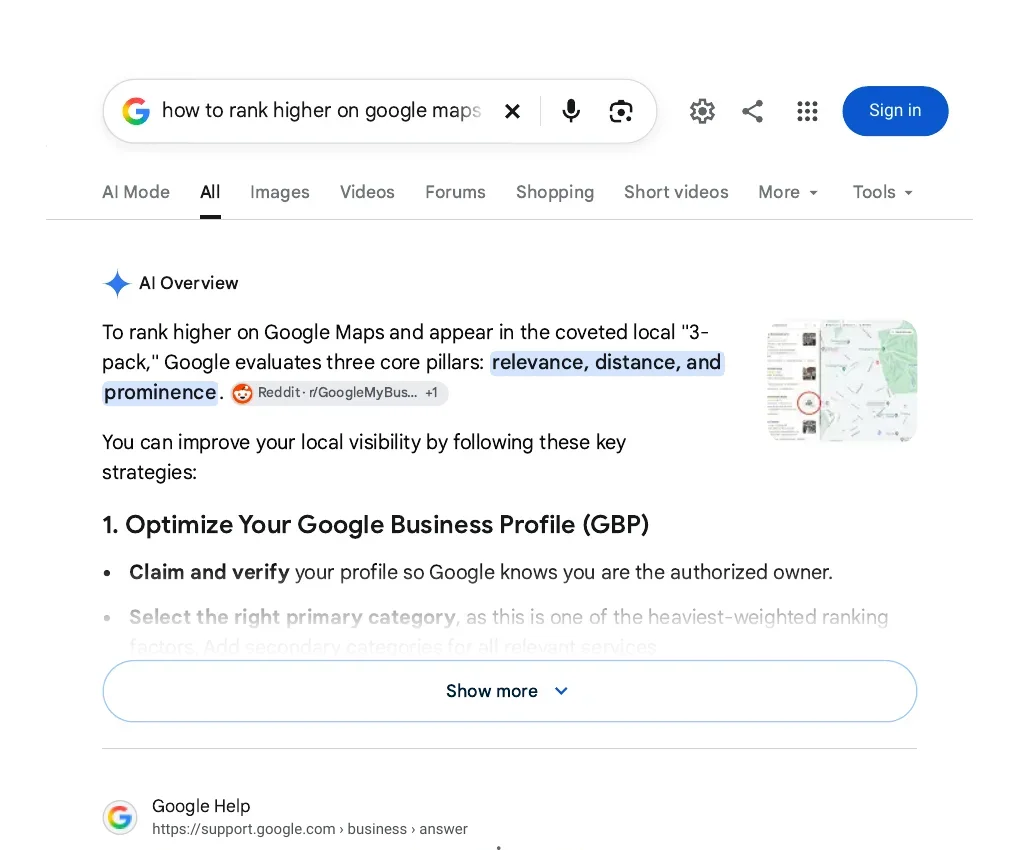
Google says local results depend mainly on three things: relevance, distance, and prominence. You cannot change where the searcher is standing, but you can improve how relevant and how well known your business looks. Relevance is whether your profile matches the search. Distance is how close you are to the searcher. Prominence is how well-known and trusted your business appears across the web — reviews, links, mentions, and complete information all feed it. Of the three, prominence is the one you can move the most.
Your profile is the single highest-leverage asset in local SEO. Get it right before anything else.
Choose the most accurate primary category — then add secondary ones that truly apply. The primary category is the strongest relevance signal you control. “Dental Clinic” beats “Dentist” if it matches your business more precisely; “Personal Injury Lawyer” beats “Law Firm.” Add every secondary category you genuinely qualify for, but don’t stuff categories for services you barely offer — irrelevant categories dilute the ones that matter. Google adds and renames categories regularly, so review your choices quarterly.
Fill in every field. Services with descriptions, hours (including holiday hours), description, attributes, and a working phone number. An incomplete profile ranks worse and converts worse. Attributes — wheelchair accessible, women-led, outdoor seating — appear as search filters; every missing attribute is a filtered search you’ll never appear in.
Add real photos, 10–15 minimum. Exterior (so customers recognize you), interior, team at work, products, before-and-after where appropriate. Add new photos monthly. Geotagged photos from real visits outperform stock imagery every time — and never use stock photos on a profile, because customers spot them instantly and trust drops.
Post weekly and monitor Q&A. Google Posts expire after 7 days (events last longer), so publish an offer, update, or news item every week — it signals an active, maintained business. Anyone can ask questions on your profile, including competitors planting awkward ones, so check the Q&A section weekly, answer everything yourself, and proactively seed the questions customers actually ask: parking, pricing, hours, services.
Your business details should match everywhere online — your website, your Google Business Profile, Facebook, and every directory. List your business in trusted directories with the exact same name, address, and phone number: “Blue Area” vs “Jinnah Avenue” vs “F-6/1” for the same location confuses Google and splits your local authority.
Start with the directories that matter in your market — Google Business Profile first, then the major data aggregators and industry-specific directories — and fix inconsistencies before adding new listings. One correct listing beats ten conflicting ones. Citation cleanup is unglamorous, but we’ve seen it move map-pack positions on its own because Google finally trusts which business is which.
Reviews influence both rankings and customer decisions — and the businesses winning locally don’t get reviews by luck, they get them by process.
Ask within 24 hours, with a direct link. The most effective method we’ve seen is dead simple: after each completed job or visit, send a WhatsApp or SMS message with the direct Google review link. No friction, no “please leave us a review sometime.” Timing matters — ask while the experience is fresh.
Reply to every review, by name. Thank positive reviewers specifically (mention what they praised), and address negative ones professionally and concretely — never with a canned response. Prospective customers read your responses to bad reviews more carefully than the reviews themselves, and Google has confirmed responses are a positive signal.
Never buy reviews or offer rewards for them. Fake reviews get detected — Google’s systems are good at this now — and the penalty is profile suspension, which wipes out years of legitimate work. One suspension costs more than a thousand genuine reviews earn.
Create a unique page for each main service and each city you serve. Write about real local details — the neighborhoods you serve, local landmarks, area-specific problems you solve — not the same text with the place name swapped. Swapped-city-name pages are exactly what Google’s scaled-content policies target.
Each page needs genuine local content, your address, an embedded map, and clear ways to contact you. If you serve F-6 through DHA, you need pages that speak to those searches individually, because “gym in G-13” and “gym in DHA” are different searches with different intent.
Local news sites, chambers of commerce, sponsorships, and partner businesses all build prominence. Even a few relevant local links help — a link from your city’s newspaper or business association carries local relevance that a hundred generic directory links don’t.
Practical ways to earn them: sponsor a local event or youth team (organizers link to sponsors), join the chamber of commerce, partner with complementary local businesses and link to each other, and pitch local journalists when you have genuine news. Digital PR for local businesses is the same discipline as our link building work, just aimed at a smaller, more relevant audience.
If you travel to customers and do not have a public shop, you can still rank. Set your service areas correctly — list the actual cities and areas you serve, not the whole country — and hide your address if Google’s rules require it for your business type. Don’t fake a storefront address you don’t staff; that’s against policy and gets profiles suspended. Cloud kitchens are a classic example: delivery-only brands like the ones in our top 10 cloud kitchens in Dubai roundup rank without any public shopfront.
Our local SEO service sets this up the right way for your model, whether you’re a plumber covering three towns or a clinic with a single location.
With consistent effort — completed profile, weekly posts, steady review flow, clean citations — ranking improvements typically appear in 4–8 weeks. That’s faster than traditional website SEO because the profile is a concentrated relevance signal. Review velocity compounds over months: the business collecting five genuine reviews a month will, over a year, be uncatchable by the competitor collecting none. If nothing moves after two months, something structural is wrong — usually the primary category, a duplicate profile, or a suspension risk in the business name.
Watch map rankings across your service area, plus calls, direction requests, and form enquiries from your profile. Rankings are a means, and enquiries are the goal. Check your profile’s insights monthly: if calls and direction requests are climbing, the work is paying off. If they’re flat while competitors grow, revisit the sections above in order.
Want more calls from nearby customers? Request a free local SEO audit and we will review your profile and listings. You can also see how this plays out on real businesses in our results, or read about the full audit process in our SEO audits guide.
Q: How long does it take to rank in the Google map pack?
A: With consistent effort — a completed profile, weekly posts, and a steady flow of genuine reviews — most businesses see movement in 4–8 weeks and solid positioning in 3–4 months. Review velocity compounds: the business earning reviews every month becomes harder to displace over time. If nothing moves after two months, check your primary category and look for duplicate profiles.
Q: Can I rank in the map pack without a physical storefront?
A: Yes. Service-area businesses — plumbers, cleaners, mobile services — can rank by setting their service areas correctly and hiding their address where Google’s guidelines require it. What you can’t do is fake a storefront address you don’t staff; that’s a policy violation and leads to suspension.
Q: Do I still need a website if my Google Business Profile is strong?
A: Yes. The profile drives calls and direction requests, but serious buyers check your website before committing — and your website powers the organic rankings below the map pack. GBP and website SEO are complementary, not substitutes. Businesses that invest in both win both surfaces.
Q: Should I respond to negative reviews?
A: Always — every review, positive and negative. Thank positive reviewers by name and mention specifics. Address negative reviews professionally and concretely, never with copy-paste replies. Prospective customers judge you more on how you handle criticism than on the criticism itself. Never buy reviews or offer incentives; the suspension risk isn’t worth it.
Q: A competitor is stuffing keywords into their business name and outranking me. What do I do?
A: Don’t copy them — keyword-stuffed names eventually get suspended, and you’d be risking your own profile. Report the violation through Google’s business redressal process with evidence. Then beat them the durable way: more genuine reviews, better photos, weekly posts, and complete information. Policy-violating competitors are running on borrowed time.

Muhammad Haris is the Founder of Onyx Growth Labs — an SEO specialist, content writer and SEO team lead. He writes the agency's guides on SEO, AI search optimisation, GEO and AEO, technical SEO, local SEO, Google Business Profile optimisation, link building and content strategy. Based in Abbottabad, Pakistan, he helps businesses worldwide get found on Google and in AI search answers.
Here is a frustration almost every Lahore business owner knows. Your SEO report says traffic is up. Rankings look fine. But the…
Read article
Leave a Reply