0:00
0:00
Speed
 By Muhammad Haris · November 16, 2026 · 6 min read
If you have read much SEO advice lately, you have met the letters E-E-A-T — usually with the implication that improving your E-E-A-T will directly improve your rankings. That implication is wrong. E-E-A-T is a useful framework for making your site genuinely trustworthy. It is not a score, and it is not a ranking factor.
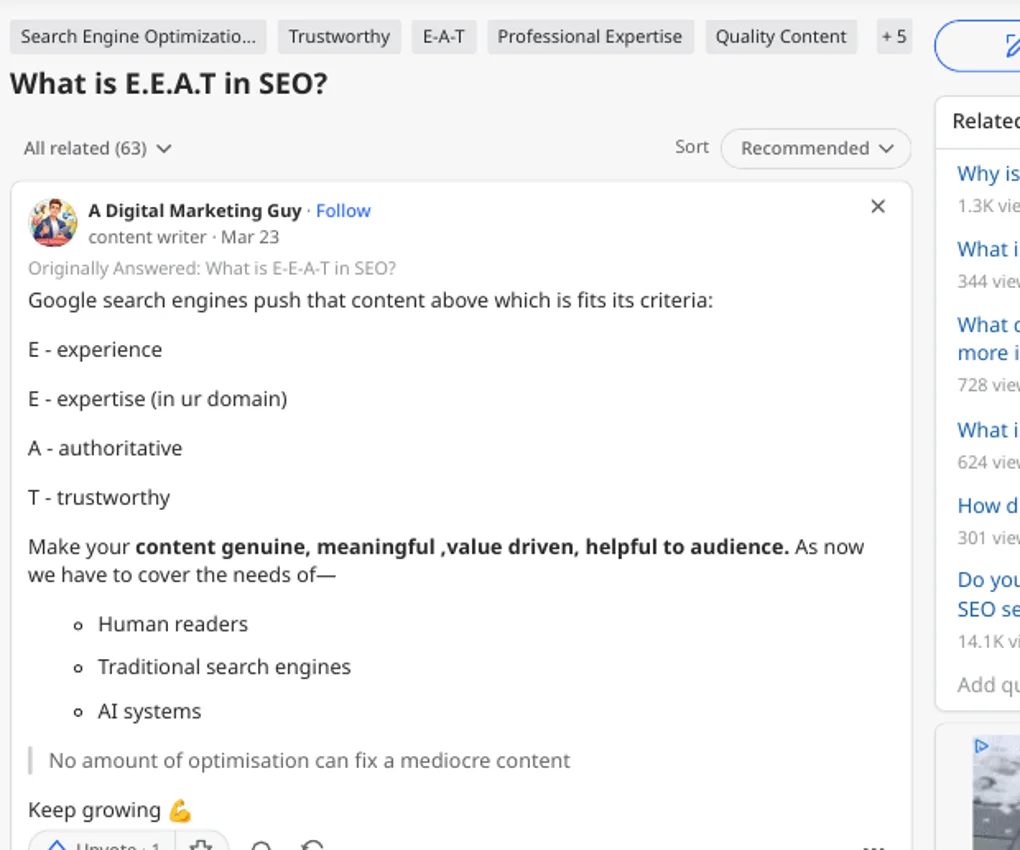
E-E-A-T stands for Experience, Expertise, Authoritativeness, and Trustworthiness. It comes from Google’s Search Quality Rater Guidelines, given to the human raters who judge search results in Google’s quality testing. Raters use E-E-A-T to assess whether a page’s content is created by people who know what they are talking about, and whether the site behind it can be trusted.
Here is the crucial distinction: raters do not set rankings. Their ratings feed into Google’s evaluation of its systems, not into the ranking of any individual page. So E-E-A-T is not something Google measures for your site and rewards with positions. It describes what high-quality, trustworthy content looks like — and content like that tends to perform well: it answers questions properly, earns links, and people trust it enough to act on it.
That distinction changes the work. Chasing E-E-A-T as a score leads to cosmetic fixes: author boxes with invented credentials, trust badges nobody checks, pages stuffed with “expert” claims. Building the real thing means making your site demonstrably more trustworthy.
They also weigh the topic. For medical or financial advice, where bad information can cause real harm, the bar is far higher and formal qualifications matter — Google calls these “Your Money or Your Life” topics. But the principle is the same whatever the topic: content should come from someone who genuinely knows the subject.
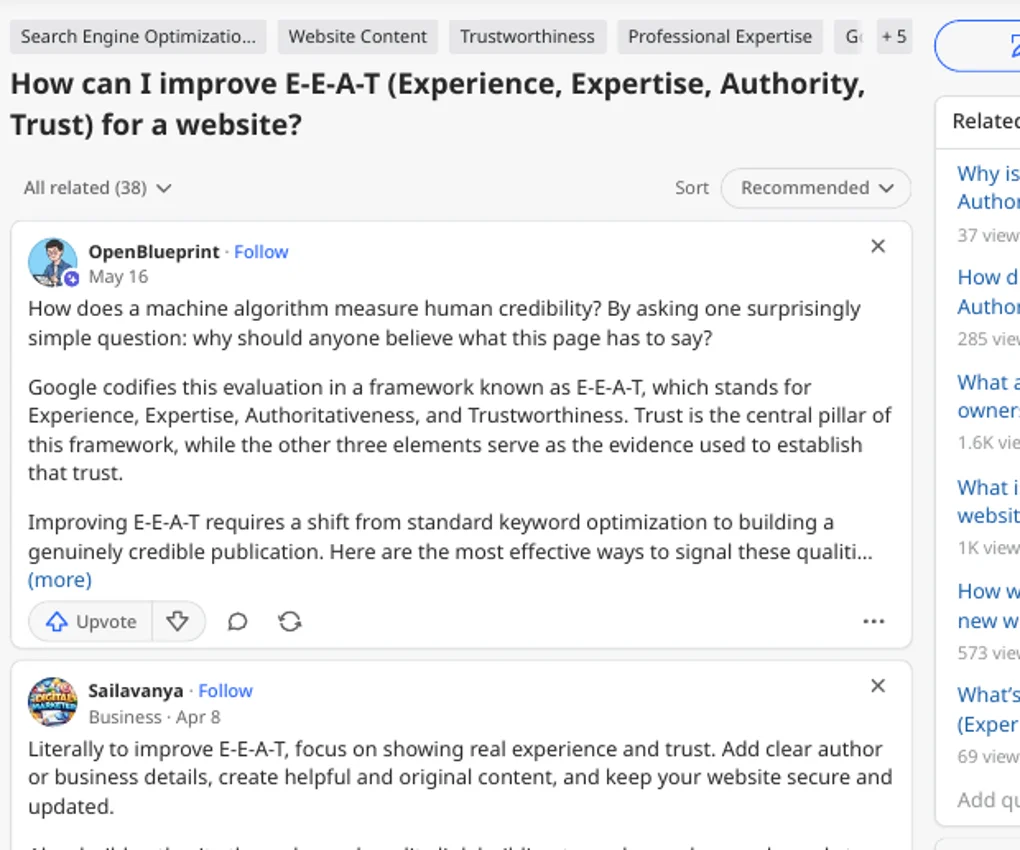
Experience, added to the older E-A-T in late 2022, asks whether the creator has actually done the thing they are writing about — used the product, done the job, lived the situation.
For a business site, experience is shown through specifics, not claims. A page that says “we have years of experience” proves nothing; a page that walks through a real process, names the tools used, and describes what went wrong and how it was fixed is experience a reader can feel. Case studies, photos of actual work, and honest discussion of limitations all count. Vague superlatives do not.
If your business has real experience, stop hiding it: put names on your content, write about jobs you actually did, and say what you learned. Readers — and raters — can tell lived detail from marketing filler.
Expertise is about knowledge: does the author understand the subject deeply enough to explain it accurately and completely? A page written by someone who knows a topic covers the awkward parts, answers follow-up questions before they are asked, and distinguishes certainty from opinion.
Depth is the tell. Thin content that restates the obvious is not expertise, however polished. A genuinely expert page explains why something works, not just that it does, covers exceptions and edge cases, and corrects common misconceptions — and that depth is what earns links and citations.
Credentials help where they are real and relevant — qualifications, years in the field, published work, stated plainly. But credentials alone do not make a page expert: a qualified author writing a shallow page has still written a shallow page.
Authoritativeness is the one letter you cannot fully control, because it lives partly off your site: do other credible sources in your field reference, cite, or recommend you?
For most businesses, authoritativeness grows from genuinely useful content other sites want to link to, mentions in industry publications, reviews from real customers, and a consistent presence in your field. One link from a respected site in your industry beats dozens of directory listings nobody reads.
This is where link building connects to E-E-A-T honestly: earning links from relevant, real sites builds the reputation authoritativeness describes, while buying links or collecting them from unrelated sites creates a profile that looks manufactured. Our guide to white-hat link building covers the earned route in detail.
Trustworthiness is the letter Google weights most heavily, and it underpins the rest: if visitors cannot tell who runs a site, how to contact it, or whether their data is safe, trust collapses.
The basics are unglamorous and non-negotiable: a real business name, a contact page with working details, clear information about who writes your content, honest pricing and terms, and a secure site. Reviews matter too — genuine ones, including imperfect ones. A profile with nothing but five-star praise looks curated, not credible.
Transparency extends to the content itself: opinion labelled as opinion, sponsored content disclosed, affiliate relationships stated plainly. Hiding the commercial angle destroys trust when discovered — and it usually is.
The most common mistake is inventing the signals instead of building them. Fake author bios — a stock photo and a made-up biography for an author who does not exist — are worse than no author bio at all, because discovery is a matter of time. The same applies to bought reviews, fabricated testimonials, and invented awards.
A second mistake is treating E-E-A-T as a checklist of widgets: an author box here, a trust badge there. None of these hurt on their own, but none substitute for the underlying reality.
A third mistake is overclaiming: a small business need only present itself honestly, as a competent business with real experience in its field. Overclaiming invites scrutiny the site cannot survive.
Start with the basics. First, make sure every page names its author and the business behind it, with a working contact page behind both. Second, replace generic claims on your most important pages with specifics from real work. Third, look at your content programme honestly — are you answering real questions in depth, or publishing pages to hold keywords? A content strategy built around real search demand is the foundation, and keyword research done properly tells you what customers actually ask.
Then look outward: an SEO audit will show the technical and content gaps, including the trust basics — missing contact details, thin author information, pages with no clear ownership. Fix those first; reputation built on a site visitors cannot trust does not hold.
Finally, be patient: trust is built by honest, useful content over time and good work. No shortcut survives inspection — which is the whole point of E-E-A-T.
Q: Is E-E-A-T a ranking factor?
A: No. E-E-A-T comes from Google’s Search Quality Rater Guidelines, used by human raters to assess content quality. Raters do not set rankings, so no E-E-A-T score is applied to your site.
Q: What is the difference between experience and expertise in E-E-A-T?
A: Experience means the creator has actually done the thing; expertise means they understand it deeply enough to explain it accurately. The strongest pages have both.
Q: How do I show E-E-A-T on a small business site?
A: Name real authors, write about real work with specific detail, state credentials honestly, keep contact details visible, collect genuine reviews, and answer real customer questions in depth.
Q: Do I need author bios on every page?
A: Author information helps, especially for advice content — but a real, brief author note beats an invented biography every time. Never use a fake author: discovery destroys more trust than an absent bio.
Q: Can E-E-A-T be improved quickly?
A: The basics can be fixed quickly — contact details, author names, honest labelling. But reputation only grows over time through useful content and real mentions. Anyone promising fast E-E-A-T gains is selling cosmetics, not trust.

Muhammad Haris is the Founder of Onyx Growth Labs — an SEO specialist, content writer and SEO team lead. He writes the agency's guides on SEO, AI search optimisation, GEO and AEO, technical SEO, local SEO, Google Business Profile optimisation, link building and content strategy. Based in Abbottabad, Pakistan, he helps businesses worldwide get found on Google and in AI search answers.
If your customers speak more than one language, an English-only website is quietly turning some of them away. Multilingual SEO is the…
Read articleIf you run a business and you have ever uploaded a video, the questions you ask first are always the same: why…
Read articleIf you run a business in Sheffield, the questions you ask before hiring SEO help are always the same: what does it…
Read article


Leave a Reply