0:00
0:00
Speed
 By Ummima Mushtaq · November 20, 2026 · 6 min read
If you run a small business on a limited marketing budget, the social media vs seo question comes up fast: social posts and ads, or search optimisation? Both promise customers, and both waste money when used for the wrong job. They do different jobs, on different timelines, measured in different ways — and that difference should be understood before spending anything.
SEO captures demand that already exists. A person types a search — a service, a problem, a nearby business — and your page appears because it answers that search best. The customer was already looking; your job is to be found, trusted, and chosen.
Social media creates demand that does not exist yet: a person scrolling a feed was not looking for your business, and your post must stop the scroll.
That distinction explains almost every argument about which channel “works”. A business measuring only enquiries will call SEO the winner; one measuring only reach will call social the winner.
SEO works through pages that rank: research what customers search for, build pages that answer those searches, fix the technical foundations, and earn links over time. The work is slow and cumulative — a page published this month may bring enquiries for years.
Social works through attention. You publish content people want to watch, share, or comment on, build a following, and convert some of that attention into enquiries — directly, or through brand familiarity that prompts a later search. The work is fast and perishable: a post’s life is measured in days.
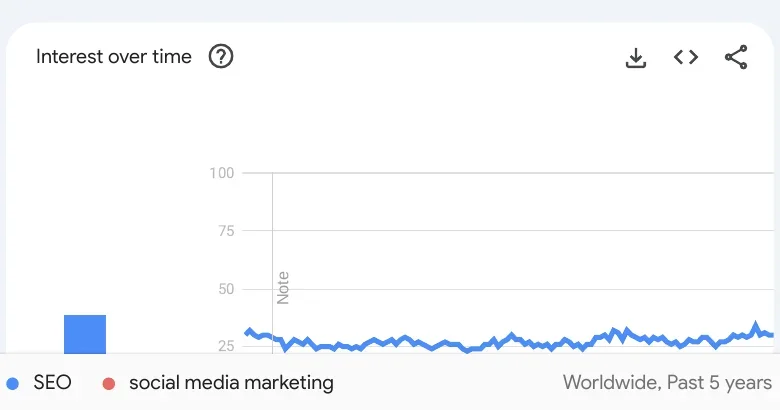
SEO is slow by nature. Technical fixes can help within weeks and local visibility within a month or two, but competitive rankings take three to six months before the trend is clear. That frustrates owners who need customers now — but once pages rank, they keep working without daily feeding.
Social is fast by nature: a post can reach people today, an ad can bring enquiries this week. That speed suits launches, events, and offers with deadlines — but stop posting and the traffic stops with it, because no asset is left behind.
A business needing customers this month with no search presence will usually get faster results from social; one wanting steady enquiries next year will usually get better returns from search.
SEO costs more upfront and less over time. The work takes months of effort, and the bill arrives before the results — but a ranking page keeps bringing enquiries without being paid for again, so the cost per enquiry falls over time.
Social costs less upfront and more over time. A single post is cheap to make, and an ad can start small. But the audience is rented: reach depends on platforms whose algorithms change without warning, and an account suspension or algorithm shift can cut a business off from its own followers overnight. Keeping the pipeline flowing means producing content continuously and often paying to boost it.
Measure SEO by enquiries, not rankings alone. Rankings for customer searches, traffic to enquiry pages, and the enquiries — calls, form fills, bookings — are the numbers that matter. A page-one ranking bringing no customers is decoration, and an SEO audit can show whether the problem is visibility, content, or conversion.
Measure social by the same standard, one step removed. Reach, likes, and followers are not customers; they are the top of a funnel. What matters is how many enquire, visit, or buy — and whether the business could reach them again without paying. A modest following producing enquiries beats a large one producing applause.
The deepest difference between the channels is ownership. Search content is an asset you own: your pages, on your site, ranking for customer searches. An algorithm update can move rankings, but it cannot take your pages away.
A social audience is rented: your followers belong to the platform, which decides how many see each post and can change that decision, suspend your account, or change its rules at any time. Businesses that built everything on one platform learned this the hard way.
That risk does not make social useless — it is a channel to use, not a foundation to build on. Move the relationship somewhere you own: your email list, your website, your customer records.
SEO fits best when customers already search for what you sell: trades, clinics, professional services, and anything people research before buying. If customers type a service and a place name into a search box, search content is where they find you.
Social fits best when the product must be seen before it is wanted: visual products, food, fashion, events, and ideas nobody searches for yet. A beautiful product or a story worth sharing travels on social in ways a search page cannot.
Local businesses often need both: social for neighbourhood familiarity, search to capture the customer when ready. Our guide to local SEO covers the search side, and keyword research tells you what customers actually search for.
There is no universal split; start with two questions. Do my customers search for what I sell? If yes, search deserves the larger share, because it captures customers at the moment of intent. Does my product sell on sight, story, or impulse? If yes, social deserves a real share too, because search alone never creates that first moment of desire.
A tight-budget business whose customers search should start with search and add social as the budget grows; a visual product with no search demand should start with social and add search pages as the brand becomes known. Measure both by enquiries, review the split every few months, and move money toward whichever channel brings customers.
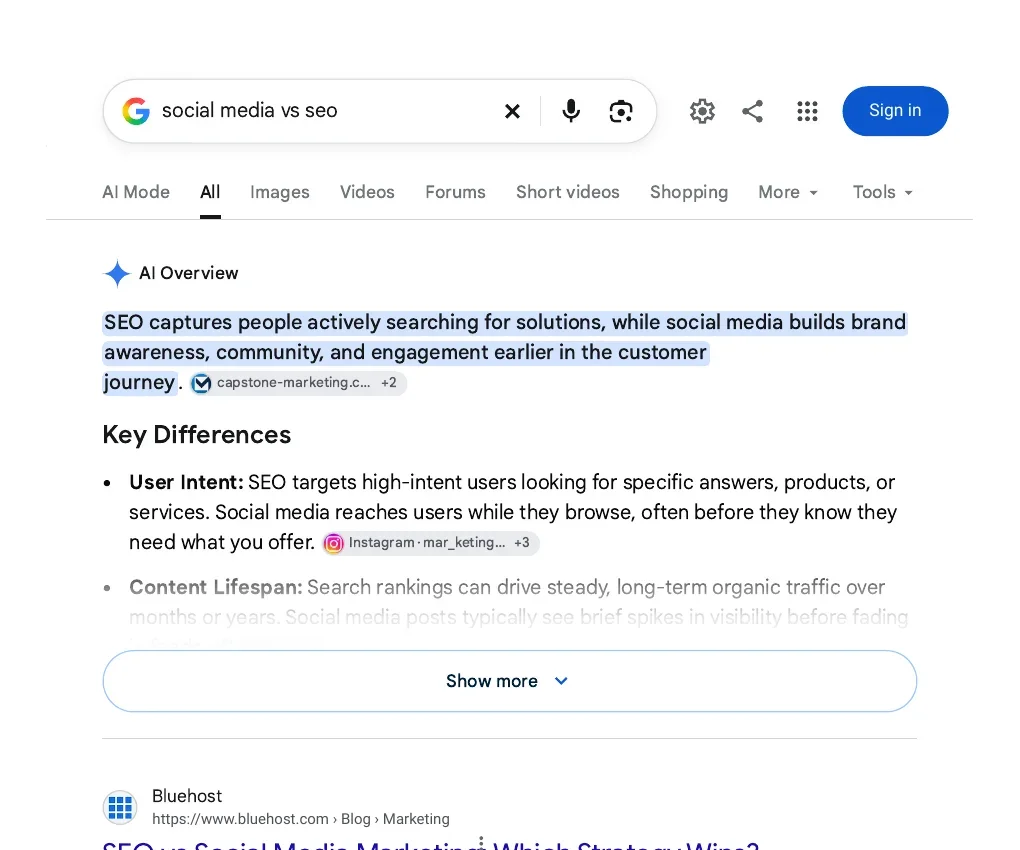
The strongest setup is rarely one channel alone. Social content that answers real questions can become search content; ranking pages shared on social can earn links and mentions; and customers who discover a business on social often search for it by name before buying.
The practical version is simple: a content strategy built around what customers ask, social to put those answers in front of people who have not asked yet, and both pointed at enquiries. If you want to talk through which split fits your business, the contact page is where a first conversation begins.
Q: Is social media or SEO better for a small business?
A: Neither is better in itself: SEO captures customers already searching, social creates interest among people not yet searching. The choice depends on whether customers search for what you sell and whether your product sells on sight.
Q: How long does each channel take to bring customers?
A: Social can bring enquiries within days or weeks; SEO takes three to six months. Social stops when posting stops; search pages keep working long after publication.
Q: Can social media replace SEO?
A: No. Social reaches people who are not searching, but it cannot capture the customer who types a service and a place name into a search box.
Q: Does social media activity help SEO rankings?
A: Not directly: social signals are not a ranking factor. Indirectly, social can help by earning links, mentions, and brand searches — but only when content is genuinely useful enough to share and cite.
Q: How should I split my budget between social media and SEO?
A: If customers search for what you sell, give search the larger share; if your product sells on sight or story, give social a real share too. Measure both by enquiries and adjust every few months.

Ummima Mushtaq is the CEO of Onyx Growth Labs, where she runs the agency day to day. She also writes the Ummima Empowers blog, covering money, work, confidence, digital safety and home business. Her work focuses on agency strategy and operations, content strategy, and helping businesses grow with clear, honest digital marketing.
If your customers speak more than one language, an English-only website is quietly turning some of them away. Multilingual SEO is the…
Read articleIf you run a business and you have ever uploaded a video, the questions you ask first are always the same: why…
Read articleIf you run a business in Sheffield, the questions you ask before hiring SEO help are always the same: what does it…
Read article


Leave a Reply