0:00
0:00
Speed
 By Muhammad Haris · August 19, 2026 · 27 min read
If you own a business and someone has told you that you need SEO, the first question is the obvious one: what is seo, actually, and what does it do for a business like yours? Search Console records no usable query for this page — the two queries it shows are noise, not questions — so this guide is built the honest way instead: from the search results for the question itself and from Google’s own documentation, with every price and every claim tied to a named source you can check. I run an SEO agency that serves clients worldwide, and I have answered this question for owners of shops, clinics, law firms, factories and online stores for years. The answer is shorter than the industry makes it sound, and this guide gives you the short version first, then the detail, then the prices, then the plan.
The short version is one sentence: SEO is the work of making your website the clearest, most trusted answer when a customer searches for what you sell. A customer types a question into Google, Google picks the pages it trusts most for that question, and SEO is everything you do to make your pages the ones it picks. That is the whole subject. The rest of this guide is how the picking works, what the work looks like, what it costs, how long it takes, and how to start — in plain English, with no jargon left unexplained.
SEO stands for search engine optimization, and Wikipedia describes it as the practice of improving the visibility and overall performance of websites and web pages in the unpaid search listings, not the ads. The term itself came into use in 1997, when the first search engines were cataloguing the early web and website owners began tuning their pages to be found. Nearly thirty years later the tools have changed and the idea has not: when someone searches for what you offer, your site should be there, and it should be the result they trust enough to click.
Google’s SEO starter guide puts it plainly: SEO is about helping search engines understand your content, and helping users find your site and make a decision about whether they should visit it through a search engine. Read that sentence twice, because it holds the two halves of the job. The first half is for the search engine: your pages must be findable, readable and clearly about one thing. The second half is for the person: your pages must answer the question, look trustworthy, and make the next step obvious. A page that does only the first half ranks and never converts. A page that does only the second half converts nobody, because nobody finds it.
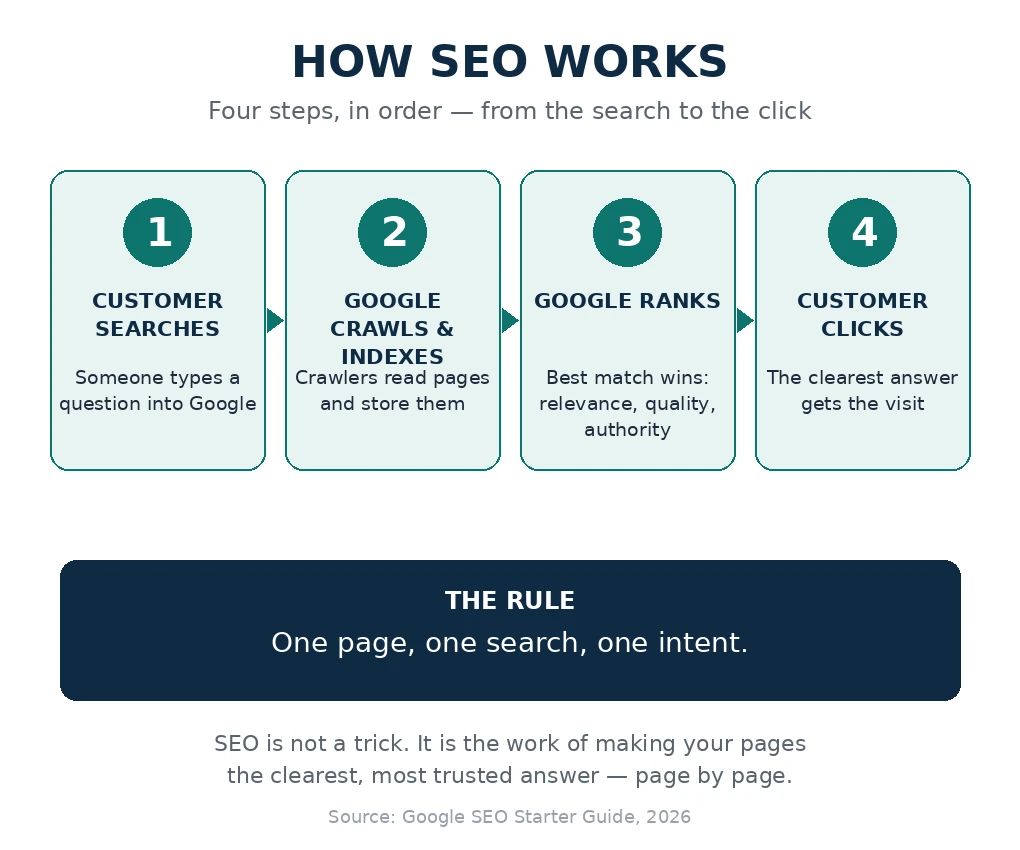
Here is how the work flows, in the order it actually happens. A customer searches. Google looks through the pages it has stored — its index — and picks the ones that best match the question, the searcher’s place, and the searcher’s intent. It orders them by relevance, quality and authority, and shows ten or so on the first page. The customer clicks the result that looks most like the answer. SEO is the work on your side of that chain: making sure Google has your pages, understands what each one is about, trusts them enough to show them, and that the person who clicks finds what they came for. Nothing in that chain is a trick, and nothing in it is instant — which is why the rest of this guide is about the parts, the price and the time, not about shortcuts.
A search engine does three jobs, and the order matters. First it crawls: automated programs, called crawlers, follow links from page to page across the web and read what they find. Second it indexes: it stores the pages it read, along with what they are about, in a vast index. Third it ranks: when someone searches, it pulls the matching pages from the index and orders them. Google’s own guide says the vast majority of sites in its results are found and added automatically as it crawls the web — you usually do not need to do anything except publish your site. The work of SEO starts after that: making sure the crawler can reach your pages, read them the way a visitor would, and understand what each one is for.
The ranking itself is a judgement, not a formula you can read. Google weighs relevance first: does this page match the topic and the intent behind the search? A searcher who types a price question wants a number, not a history of the service; a searcher who types a how-to question wants steps, not a brochure. Then it weighs quality: is the page helpful, reliable and written for people, not for rankings? Google’s starter guide says creating content that people find compelling and useful will likely influence a site’s presence in search results more than any of the other suggestions in the guide — the strongest line in the whole document, and the one most SEO sellers skip. Then it weighs authority: do other trustworthy sites link to this page, mention this business, and treat it as a real one? A page with all three — relevant, useful, trusted — is a page Google is glad to show.
Two things about ranking are worth knowing before you spend anything. The first is that Google says it plainly in the same guide: there are no secrets that will automatically rank your site first. Anyone selling you a secret is selling you something Google has already said does not exist. The second is that a ranking is a means, not the measure. The measure is what happens after the click — the enquiry, the call, the sale. A page that ranks first and never converts is a page that answers the wrong question, and no position fixes that.
Almost every guide to what is seo splits the work the same way, because the split is real: three parts, and a programme that ignores any one of them underperforms. The three are on-page, off-page and technical, and each one answers a different question about your site.
On-page SEO is everything you control on the page itself: the title, the meta description, the headings, the content, the images, the URLs, the internal links and the schema. The title is the line Google shows as the clickable headline in the results — Google calls it the title link — and Google’s guidance on title links says it is the headline that helps people decide which result to click, so it should name the topic first and the brand last, in about 50 to 60 characters. The meta description is the grey text under the title; it is not a ranking factor, and its whole job is to persuade someone to click, so write it like a promise: what the page is, who it helps, and what the reader gets. Headings work as a table of contents: one H1 that names the subject, then H2s and H3s for the parts underneath, in order. And the content itself is judged by Google’s guidance on creating helpful content, which rewards pages written for people, not for rankings — the test, as ever, is whether a reader finds anything on the page that is actually useful to them.
Off-page SEO is the authority work that happens away from your pages: links from other websites, mentions of your business, reviews and citations. A link is a vote, but only a real one counts — our guide to what is link building explains what a real link is and what a bought one looks like, and our guide to off-page SEO services explains what real off-page work is and what the bulk packages are not. The short version is that a real link survives being looked at, so ask to see the live link, not just a domain name.
Technical SEO is the work that decides whether Google can reach, read and render your pages at all: crawlability, indexation, speed, mobile rendering and the server underneath. The technical SEO work behind speed is worked through in priority order, because slow pages cost you visitors before they cost you rankings. A page that cannot be crawled cannot rank, whatever its title says, and a page that can be crawled but says nothing clearly will not rank either. The three parts are bought together more often than apart — but they are three jobs, and a quote that names one price for all three is a quote you cannot check.
Half of understanding SEO is knowing what it is not, because the confusion costs money in both directions. SEO is not advertising. An ad buys a place at the top of the results for as long as you pay, and the moment the budget stops, the ad disappears. SEO earns a place in the unpaid results, and that place keeps delivering visitors after the work is done. The two are different channels with different economics, and the comparison deserves its own section below.
SEO is not a trick. The industry has a name for the tricks — black hat SEO — and the recorded history of the subject lists them plainly: hidden text, link schemes, pages built for crawlers rather than people. Search engines have spent thirty years building defences against exactly those tactics, and the defences work: a trick that ranks today is a penalty waiting for the next update. The honest version — white hat SEO — is slower and duller: clear pages, real content, real links, real reviews. It is also the only version that survives.
SEO is not a one-off job, and it is not a plugin. A plugin can check that a title exists, but it cannot decide which search a page should own. An audit can list what is wrong, but the audit is a document, not the work — the work is the fixing, page by page, month by month. And SEO is not a guarantee. No honest company promises a position or a date, because no company controls Google. A seller who guarantees first place is telling you, in the same sentence, that they do not understand the product.
The question every business owner asks next deserves a number, not a sales call. Two Pakistani agencies publish their prices openly, and their bands overlap almost exactly — which is the market speaking, not one seller. SEOISB prices its on-page service in three tiers: Starter at $320 a month for ten pages optimised, with a title and meta rewrite and a cannibalisation report; Growth at $770 a month for thirty pages, with content gap expansion, an internal link build-out and schema implementation; and Scale at $1,600 a month for a hundred or more pages across four markets, with template-level optimisation and multi-language work. Every tier includes a named strategist and monthly reporting, and the minimum term is three months.
MediaLinkers prices the same work in three tiers of its own: Basic at $400 a month, down from $500, with keyword research for up to ten target keywords, on-page optimisation of titles, meta, headings and URLs, a basic technical audit and one blog post; Standard at $850 a month, down from $1,000, with twenty-five keywords, full on-page optimisation and internal linking, three blog posts and five backlinks a month; and Premium at $1,300 a month, down from $1,500, with fifty or more keywords, a complete on-page and technical overhaul, five blog posts and ten backlinks a month. The two agencies were written independently, and their bands sit in the same range — a starter tier in the low hundreds, a growth tier in the high hundreds, and a scale tier above a thousand.
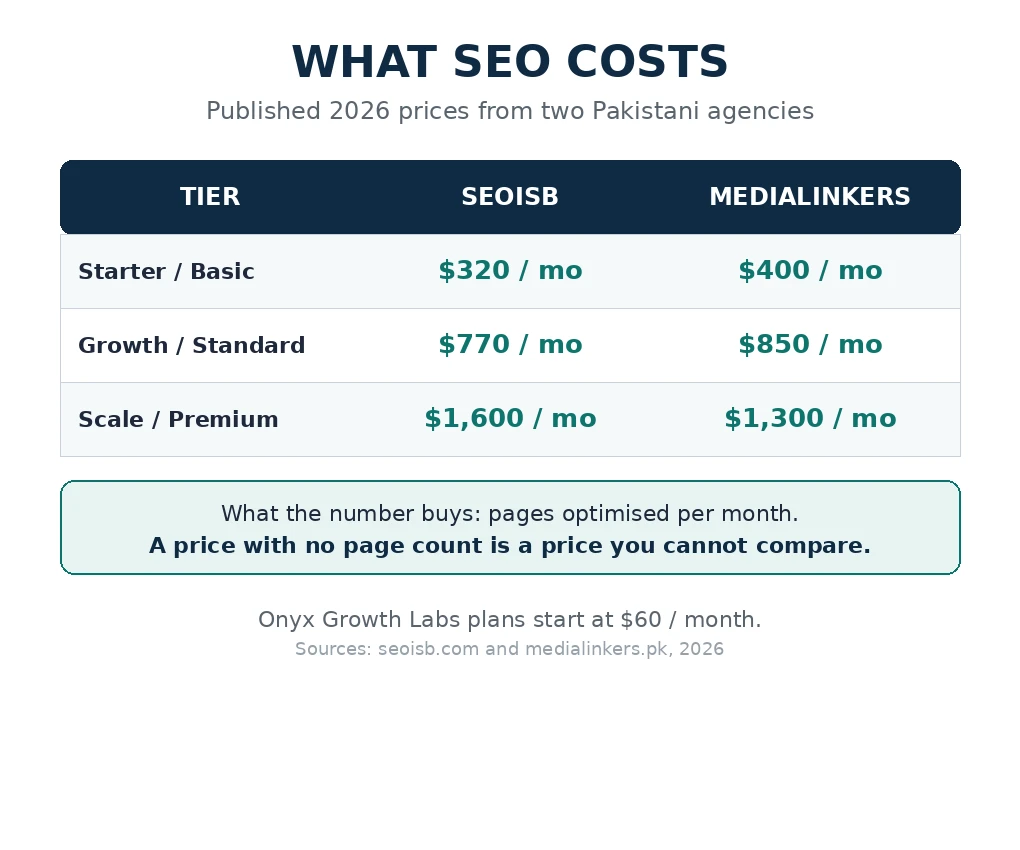
What the number buys is the question that matters more than the number. A $320-a-month engagement buys ten pages optimised, a title and meta rewrite, and a report. A $770-a-month engagement buys thirty pages, content expansion, internal links and schema. A $1,600-a-month engagement buys a hundred or more pages across four markets, with a senior team and a dedicated content lead. Our guide on how much SEO costs covers the five factors in detail — scope, competition, site size and condition, who does it, and where they are — and the plain version of those five factors is simple: a ten-page site costs less than a hundred-page site, a competitive market costs more than an easy one, and a team costs more than a person. The page count is the first thing to check on any quote, because a price with no page count is a price you cannot compare.
Our own plans start lower than either agency above: plans from $60 a month, with Small Business Starter plans at $60, $150, or $399 a month, Growth at $899, and Scale at $1,799. The starter tiers are for a small site with a clear brief; the scale tiers are for a site with a hundred pages and several markets. Choose on the shape of the job, not on the size of the seller — and if a quote cannot tell you which pages, which jobs on each one, how many hours and what the report contains, it is not a quote, it is a blank cheque.
The honest comparison starts with what each channel does when you stop paying. Paid ads stop the day the budget stops: no money, no visitors, no trace. SEO keeps delivering after the work is done, because a page that ranks keeps being found for months or years with modest upkeep. That is the compounding nature of organic search, and it is the reason SEO usually ends up the cheapest way to win a customer over time — the cost of one more visitor from a page that already ranks is close to zero, while the cost of one more visitor from an ad is the price of the click, every time.
The numbers behind that claim are worth quoting with their source attached. MediaLinkers publishes two figures on its own site: that more than half of total website traffic comes from organic search, and a 14.6% conversion rate from SEO against 1.7% for outbound marketing. Those are their published figures, not ours, and they point the same way as every other study on the subject: a searcher who typed your service into Google is further along the buying journey than someone scrolling a social feed, so the visitor is worth more. A click from a search is a person who already wants what you sell. A click from an ad is a person you interrupted.
That does not make ads useless. Ads are the right tool when you need visitors this week — a launch, a seasonal offer, a new location — and SEO is the right tool when you need visitors every week for years. Most businesses that can afford both should run both, with the ads buying time while the SEO builds. But if you can only afford one, and your business will still be there in a year, the answer is SEO first: the ads rent you the top of the page, and SEO is the slow purchase of the same ground.
The timeline question has an honest answer and a sales answer, and they are different. The sales answer is thirty days. The honest answer is that Google itself says some changes might take effect in a few hours and others could take several months, and that in general you should wait a few weeks to assess whether your work had beneficial effects. A title change can move a page in days. A content expansion takes weeks to be read and re-ranked. A full programme takes months to show across a whole site, because the pages need to be crawled, linked and read together before Google treats them as a set.
Give the work ninety days, not nine, and judge it on pages fixed and movement in the numbers. The fastest movement comes from the pages already closest to ranking — the ones sitting in positions five to twenty, where a better title and a deeper answer can move them onto page one in weeks rather than months. SEOISB’s published process says the same thing: start with the pages already ranking in positions five to twenty, because those are the quickest wins. A programme that starts with the blog and leaves the service pages untouched has started at the wrong end, because the blog brings readers and the service pages bring customers.
One more timing rule belongs here, because it is where most owners lose patience. A new site, or a new market version, needs its own history before it ranks: its own links, its own reviews, its own months of being crawled. There is no honest way around that, and any seller who promises to skip it is selling you a trick with a short life. The work compounds, but it compounds slowly at first — which is why the cheapest time to start was a year ago, and the second cheapest time is today.
If your customers come from a place — a city, a neighbourhood, a street — then local SEO is the part of SEO that pays first, and it is the part most small businesses skip. A local search is a search with a place in it: “plumber near me”, “best dentist in Lahore”, “SEO company in Abbottabad”. Google answers those searches with a map pack — the three business listings with a map at the top of the results — and the businesses in that pack get the calls. Our local SEO checklist runs through the same checks in order — profile, citations, pages, reviews, links, tracking — because the order is the method, and a local page that is not backed by a complete profile is a page the map pack will ignore.
The profile is the first job, and it is free. A Google Business Profile is the listing Google shows in the map pack and on Maps: your name, address, phone, hours, photos, services and reviews. Set it up, verify it, fill in every field, and keep the hours and photos current. Our guide on how to rank higher on Google Maps covers the map pack in detail — the profile, the reviews, the citations and the pages that support them — and a service page that ranks while the profile does not is a job half done.
The second job is reviews, and the rule is simple: ask every happy customer, and answer every review, good or bad, in your own words. Reviews are a ranking signal and a trust signal at once — a business with forty recent reviews is believed before a business with four old ones, and Google reads the words in the reviews as well as the stars. The third job is consistency: the same name, address and phone number everywhere your business is listed, because a business whose details disagree across the web is a business Google is unsure about. Local SEO is the least technical part of the whole subject, and for a small business it is usually the highest return on an hour of work.
The newest question about SEO is the one buyers ask now: what happens when the customer asks an assistant instead of typing a query? A buyer now asks ChatGPT or Google’s AI Mode for an answer, and the assistant answers from the pages it trusts — a named business, a complete profile, real reviews, and a page that answers the question clearly. The work has new names — answer engine optimization and generative engine optimization — but the published summary of the change is reassuring: Google states that its AI Overviews and AI Mode do not require additional technical optimization beyond the existing requirements for appearing in Search, and established practices such as allowing crawling, using internal links, providing accessible text and keeping content useful, reliable and people-first still apply.
That means the answer to “does AI change SEO?” is mostly no, with one real change. The no is that the foundations are the same: a page that is clear, cited, and trusted is the page an AI answer quotes, just as it is the page a search result shows. The change is that the click is no longer guaranteed — an AI answer can satisfy the searcher without a visit, so the pages that win are the ones with something worth clicking for: a price, a step, a tool, a worked example, a name to call. Thin pages lose twice in the AI age: once in the ranking, and once in the answer.
The same test as ever decides whether your content is ready. Google Search Central’s guidance on AI-generated content says what matters is whether the content is helpful and accurate, not how it was produced — the same test as ever: did the page help the person who searched? Our guide to how to track AI visibility shows the checks we run on the AI side of search — the citations, the brand mentions, the answers that name you — and the GEO vs SEO vs AEO comparison explains how these visibilities relate. Watch the AI side in the same monthly check as the rankings, because the pages you optimise now feed more than rankings.
If you want to start this month, here is the plan in four weeks — one week per step, no tools you have to pay for, and every step checkable on the live site when it is done.
Week one is the audit. Set up Google Search Console and Google Analytics if they are not already running — both are free, and Search Console is the only tool that reports what Google itself saw: which pages it indexed, which queries brought impressions, and which errors it found. Then run an audit of the site as it stands. Our guide on how to do an SEO audit separates technical problems from content and authority ones — the audit tells you which half of the work your site needs, and the month that follows is the work, not another document. Write down the three biggest problems, in plain words, before you fix anything.
Week two is the keyword map. List the searches your customers actually use, in their own words, and match each one to a page. Our guide on how to do keyword research walks through finding the searches customers actually use, and grouping searches so each page targets one clear intent is the same discipline as keyword clustering — the point is not the biggest keyword list, it is intent: is the searcher learning, comparing, or ready to buy, and which page answers them? Our guide on what to do after keyword research turns that list into a plan, step by step — the research is not the deliverable, the map is.
Week three is the pages. Take the ten pages already closest to ranking and fix each one in the same order: a title that names the topic first, a meta description that says what the reader gets, one H1 with logical H2s underneath, content that answers the question and then the next one, and internal links to the pages that matter. Week four is the gaps and the links: fill the subtopics the ranking pages cover and yours does not, link where the reader’s next question lives, and then measure — the same numbers, compared with last month, from Search Console. A month of this is enough to know whether SEO is working for your business, and it is the month every honest programme starts with.
Sooner or later most owners decide to hire, and the question behind that decision is the one that matters: how do I tell a real company from a checklist with a logo? Five checks, about an hour each — less time than fixing a bad hire.
Check one: the live work. Ask for three pages the company optimised, and open them yourself. A real service leaves pages you can read: a title that names the topic, headings that work as a table of contents, content that answers the question, images with real alt text, and links that go somewhere useful. If the company cannot show you a page, it has not done the work. Check two: the before-and-after report. Ask to see what changed on one page, and what happened after it changed — the ranking before, the ranking after, the clicks before, the clicks after, with the dates. A real company answers with names, hours, and last month’s fixes.
Check three: the written scope. Before you pay, get the work in writing: which pages, which jobs on each one, how many hours, who does them, and what the report contains. A scope that says “SEO” and a price is not a scope — it is a blank cheque. Check four: the references. Ask for two clients you can call, and call them. Check five: the guarantees. There are none, and any company that offers one is disqualified on the spot. Google’s guidance on hiring an SEO says the same thing in plainer terms — ask for references, check their work, and be wary of guarantees — and our guide on how to choose an SEO agency covers the same kind of vetting, fifteen questions, a written scope, and no promises you cannot check.
If you buy SEO services online, you will meet every tier of help in the same search results, from a freelancer for one narrow job to an agency for the whole plan — buy the thing the site needs, not the thing the seller is selling. A freelancer suits a small site with ten pages and a clear brief; a company suits a site with a hundred pages and several markets. Choose on the shape of the job, not on the size of the seller.
The last step turns the work into a system instead of a project. A programme is working when the pages move, the clicks move, and the movement can be tied to the work — and none of those three is visible from a single rank check. Check the pages first: open the pages the work touched and confirm the work is there — the title, the headings, the content, the images, the links, the schema. A report that lists changes nobody can see on the live page is a report about a document, not about a website.
Then watch the right numbers, in the right order. The first number is the ranking of the pages that were optimised, for the searches they own — and the honest starting point is the pages already in positions five to twenty, because those are the ones a better title and a deeper answer can move onto page one. The second number is clicks and impressions for those pages, from Search Console, which is the only tool that reports what Google itself saw. The third number is the enquiries those pages bring, because a page that ranks and never converts is a page that answers the wrong question. And the timeline tells you whether to wait or to stop: a title change can move a page in days, a content expansion takes weeks, and a full programme takes months. Give the work ninety days, not nine, and judge it on pages fixed and movement in the numbers.
The reporting follows the same clock as the rest of the site. Our guide to the SEO monthly report generator shows what a good monthly report looks like — live URLs you can click, Search Console numbers you can read, one sentence per change. Our guide on how often should you do an SEO audit covers the review cadence in detail — the full audit twice a year, the monthly check in between — and the SEO report follows it: once a month, the same numbers, compared with last month. If the numbers move and the enquiries move with them, the programme is working. If the numbers move and the enquiries do not, the pages are answering the wrong question — and that is a map problem, not a ranking problem.
SEO is the work of making your website the clearest, most trusted answer when a customer searches for what you sell: findable pages, one search and one intent per page, titles and descriptions that earn the click, content that answers the question and the next one, links that prove other sites trust you, and a profile and reviews that prove you are real. It costs a few hundred a month for a small site and more for a large one, it takes ninety days to show movement, and it keeps paying after the work is done — which is why it is usually the cheapest way to win a customer over time.
Start with the audit, map one page to one search, fix the ten pages closest to ranking, and measure the same numbers every month. If it works, you have a channel that brings you customers while you sleep. If it does not, you have a map, and a map can be fixed.
Our agency runs SEO the same way we run everything else — with the audit first, a written scope second, and the earned links third. Our content strategy service plans the topics and clusters, our link building services earn the authority, and our local SEO services handle the map pack and reviews for the offices and locations that need them. We also run full SEO audits of our own, with the same fix-first order this guide describes, and our white-label SEO services deliver the same work under your agency’s brand. The full plans are published on the site, and if you want to talk through your situation first, book a free consultation and we will tell you honestly whether you need us at all. You can also see what our work has delivered on our results page. Our plans start at $60 a month, with Small Business Starter plans at $60, $150, or $399 a month, Growth at $899, and Scale at $1,799 — you can see the plans and prices on our pricing page. The searcher already knows the question now. Answer it in five seconds — and hire the firm that is glad you asked.
SEO — search engine optimization — is the work of making your website the clearest, most trusted answer when a customer searches for what you sell. When someone types a question into Google, Google picks the pages it trusts most for that question, and SEO is everything you do to make your pages the ones it picks: findable pages, clear titles and content, and links and reviews that prove you are real.
In three steps. Google crawls the web with automated programs that read pages, it stores the pages it read in an index, and when someone searches it pulls the matching pages from the index and orders them by relevance, quality and authority. SEO is the work on your side of that chain: making sure Google can reach and understand your pages, and that the person who clicks finds what they came for.
On-page SEO is everything you control on the page itself — titles, meta descriptions, headings, content, images, URLs, internal links and schema. Off-page SEO is the authority work away from your pages — links from other websites, mentions, reviews and citations. Technical SEO decides whether Google can reach, read and render your pages at all — crawlability, indexation, speed, mobile rendering and the server underneath. A programme that ignores any one of the three underperforms.
Two Pakistani agencies publish their prices openly: SEOISB charges $320 a month for ten pages, $770 for thirty pages, and $1,600 for a hundred or more pages across four markets; MediaLinkers charges $400, $850, and $1,300 a month for its Basic, Standard, and Premium tiers. Our own plans start at $60 a month. The page count is the first thing to check on any quote, because a price with no page count is a price you cannot compare.
A title change can move a page in days; a content expansion takes weeks to be read and re-ranked; a full programme takes months to show across a whole site. Google itself says some changes take effect in a few hours and others take several months. Start with the pages already in positions five to twenty, where a better title and a deeper answer can move them onto page one. Give the work ninety days, not nine.
For the long term, usually yes: ads stop the day the budget stops, while a page that ranks keeps delivering visitors for months or years. MediaLinkers publishes a 14.6% conversion rate from SEO against 1.7% for outbound marketing on its own site. But ads are the right tool when you need visitors this week — a launch, a seasonal offer, a new location — and most businesses that can afford both should run both, with the ads buying time while the SEO builds.
Yes, for a small site: set up Google Search Console, audit the site, map one page to one search, fix the ten pages closest to ranking — a title that names the topic, a meta description that says what the reader gets, one H1 with logical H2s, content that answers the question — and measure the same numbers every month. A site with a hundred pages, several markets, and a team needs a company with a named strategist and a shared roadmap.
Yes. We run SEO the same way we run everything else — with the audit first, a written scope second, and the earned links third — the three parts of SEO on the pages that matter, with a monthly report you can click through. Our plans start at $60 a month: Small Business Starter at $60, $150, or $399, Growth at $899, and Scale at $1,799. Talk to us first and we will tell you honestly whether you need us at all.

Muhammad Haris is the Founder of Onyx Growth Labs — an SEO specialist, content writer and SEO team lead. He writes the agency's guides on SEO, AI search optimisation, GEO and AEO, technical SEO, local SEO, Google Business Profile optimisation, link building and content strategy. Based in Abbottabad, Pakistan, he helps businesses worldwide get found on Google and in AI search answers.
Leave a Reply