0:00
0:00
Speed
 By Muhammad Haris · November 11, 2026 · Last updated: November 19, 2026 · 6 min read
If your customers now get answers from AI summaries instead of a list of links, ranking on page one is no longer the whole story. ai visibility tracking tools answer a different question: when someone asks an AI assistant about your topic, does your business appear — and if so, what does it say about you? This guide covers what to measure, what these tools can and cannot tell you, and how to choose one without falling for dashboards full of meaningless numbers.
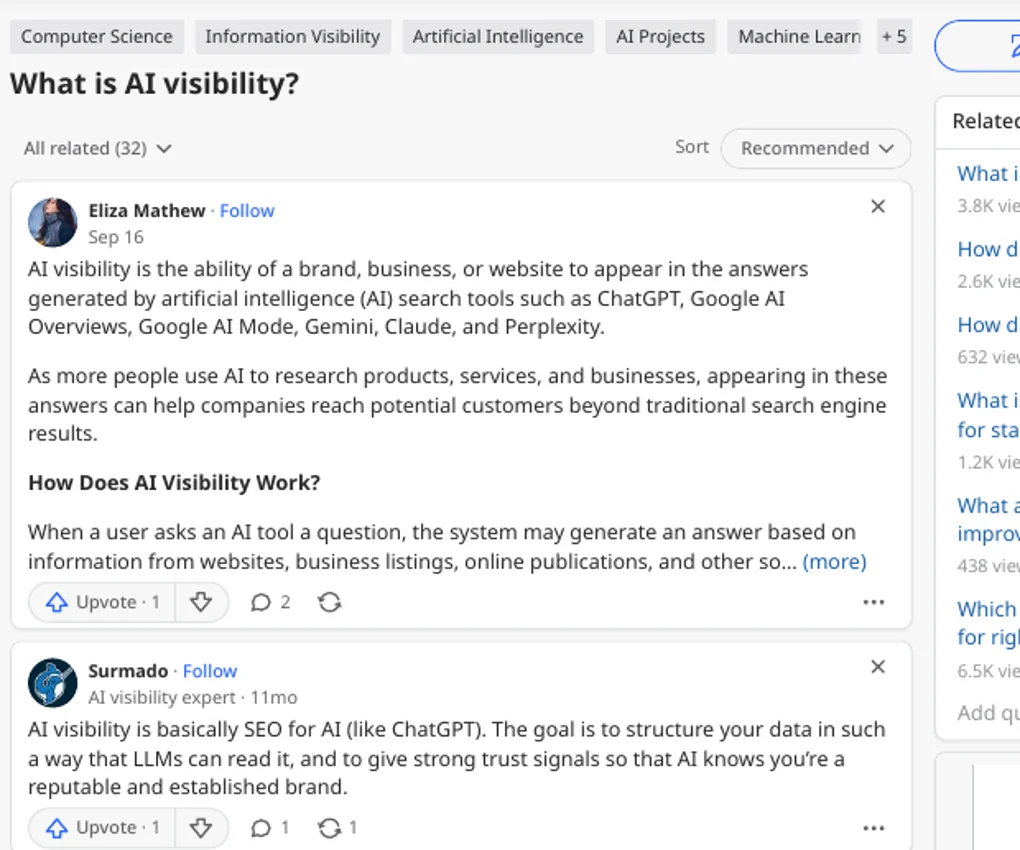
AI visibility is not a ranking. It is whether, and how, your business shows up inside AI-generated answers: a citation linking to your page, a mention of your brand name, a recommendation in a comparison, or a summary built from your content. A business can rank well in traditional search and still be invisible in AI answers, because AI systems draw on sources they can parse confidently — clear pages, direct answers, structured facts — rather than simply the top ten results.
That is why tracking matters. Without it, you are guessing whether your content is being cited, ignored, or misrepresented. With it, you can see which of your pages AI systems trust, which topics you are absent from, and where competitors are being cited instead of you.
A useful tool tracks five things, and any tool missing most of them is a vanity dashboard.
First, citations: how often your pages are linked or referenced inside AI answers, and for which prompts. A citation is the strongest signal, because it means the system treated your page as a source worth pointing to.
Second, brand mentions: how often your business name appears in AI answers, with or without a link. Mentions matter even without a citation, because the searcher still sees your name — but they matter less, because there is no path back to your site.
Third, share of answers: for a set of prompts that matter to your business, how often do you appear compared with competitors? This is the closest thing AI tracking has to a ranking, and it is the number that tells you whether you are winning or losing a topic.
Fourth, sentiment and accuracy: what the AI answer actually says about you. A mention that misstates your services, prices, or location is worse than no mention at all, and a tool that counts mentions without showing the wording hides the problem.
Fifth, prompt coverage: which questions your business appears for, and which it does not. The gaps are often more useful than the wins, because they show exactly which topics need new or better content.
Honest limits matter here, because this is a young category and some tools overpromise.
What tools can tell you: which prompts trigger mentions of your business, which pages get cited, how your share of answers compares with competitors over time, and whether the wording about you is accurate. Tracked consistently, that is enough to guide content work.
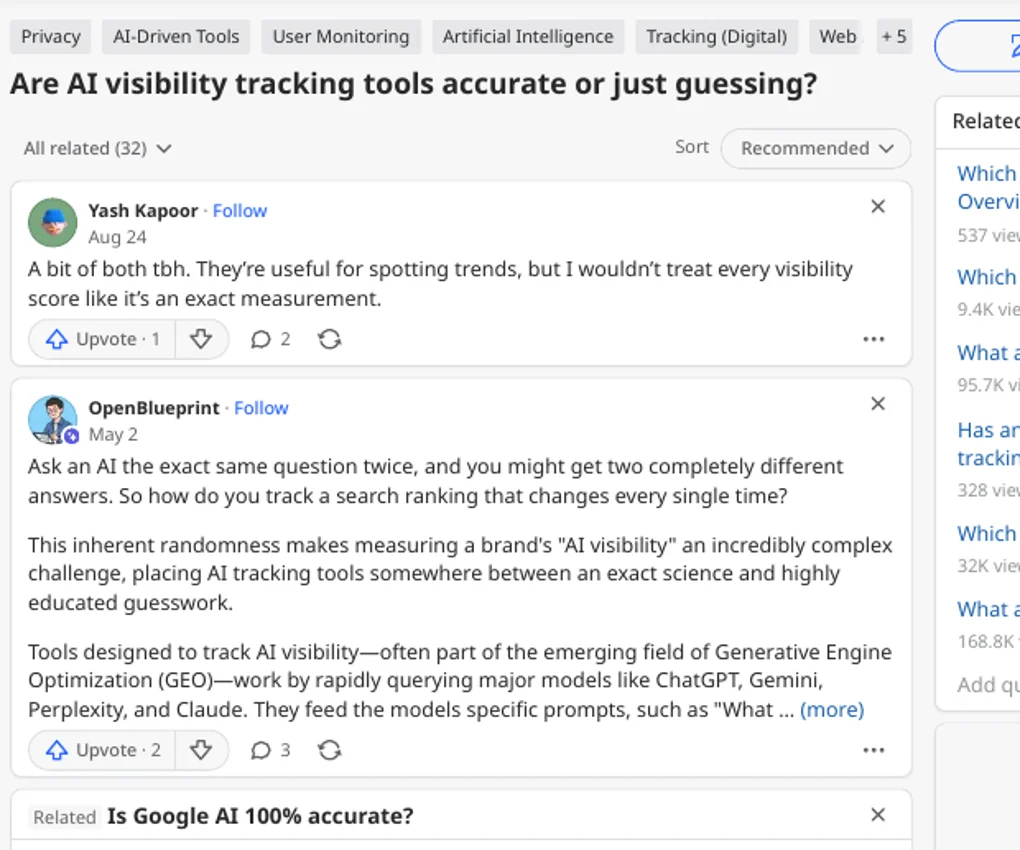
What they cannot tell you: exactly why an AI system cited one page and not another, what will happen next month, or how many customers an AI mention produced. AI answers are generated, not retrieved from a fixed list, so the same prompt can produce different answers at different times. A tool that presents a single snapshot as a precise score is dressing up variation as certainty. Treat every number as a trend over weeks, not a verdict on one day.
Tools also cannot fix the underlying problem. If your pages are vague, out of date, or hard for a machine to parse, no tracking tool will make AI systems cite them. Tracking shows you where to work; the work itself is still content, structure, and accuracy.
Start with your prompt list, not the tool’s feature list. Before comparing anything, write down the questions your customers actually ask — the ones that lead to enquiries, not the ones that sound impressive. A tool is only useful if it tracks those prompts, in the AI systems your customers actually use.
Then judge tools on four criteria. Coverage: does it track the AI platforms and languages your customers use, or only one? Transparency: can you see the actual answers behind the numbers, including the wording about your business? Frequency: how often does it re-check prompts, given that AI answers change? And actionability: does it connect a gap to a next step — which page to improve, which topic to cover — or does it only report a score?
Price follows from those answers, not the other way round. A cheap tool tracking the wrong prompts costs more than an expensive one tracking the right ones, because it sends your content work in the wrong direction. And be wary of any tool promising guaranteed AI visibility: nobody controls what an AI system cites, and a promise to the contrary is a sales line, not a plan.
Tracking only pays when it changes what you publish. The loop is simple and worth running monthly.
First, look at the gaps: prompts where competitors are cited and you are not. Those are content briefs — the topic is proven to matter, and someone else’s page is currently the source AI systems trust. Ask what their page does that yours does not: a clearer answer, fresher facts, better structure.
Second, look at the inaccuracies: answers that misstate what you do. Those are fixes to your own pages — clearer wording, corrected facts, a page that states the answer plainly instead of burying it.
Third, look at the wins: pages already being cited. Protect them. Keep them current, keep their facts accurate, and link related content to them so the authority they earn flows through your site. A cited page that goes stale is a citation waiting to move to a competitor.
For the wider picture of how AI answers work and what makes a page citable, see the guide to how to track AI visibility and the account of how we rank in AI overviews. The distinction between search, answer-engine, and generative optimisation in GEO vs SEO vs AEO explains why AI visibility needs its own measurement rather than a repurposed ranking report. And when tracking shows a topic gap, the content strategy is where that gap becomes a publishing plan.
Q: What do AI visibility tracking tools measure?
A: Citations, brand mentions, share of AI answers for a set of prompts, the sentiment and accuracy of what AI answers say about you, and which prompts you appear for versus your competitors.
Q: Can a tool guarantee my business appears in AI answers?
A: No. Nobody controls what an AI system cites. A tool can show you where you appear and where you do not, and guide the content work that earns citations — but a guarantee is a sales line.
Q: How is AI visibility different from search rankings?
A: Rankings measure position in a list of links. AI visibility measures whether your business appears inside generated answers, as a citation, a mention, or a recommendation — a different result that needs its own tracking.
Q: How often should AI visibility be checked?
A: Monthly, as a trend. AI answers vary from day to day, so a single snapshot misleads; a trend over weeks shows whether your share of answers is genuinely rising or falling.
Q: Do I need a tool, or can I check AI visibility manually?
A: You can start manually by asking AI assistants your customers’ questions and noting what appears. A tool becomes worthwhile when the prompt list grows too large to check by hand, or when you need competitor comparison over time.

Muhammad Haris is the Founder of Onyx Growth Labs — an SEO specialist, content writer and SEO team lead. He writes the agency's guides on SEO, AI search optimisation, GEO and AEO, technical SEO, local SEO, Google Business Profile optimisation, link building and content strategy. Based in Abbottabad, Pakistan, he helps businesses worldwide get found on Google and in AI search answers.
If you lead marketing for a large organisation, you have probably discovered that SEO advice written for small businesses does not scale…
Read articleIf you run a small business on a limited marketing budget, the social media vs seo question comes up fast: social posts…
Read articleIf you have started checking whether your business appears in AI answers, you have probably found a new problem: a growing number…
Read article


Leave a Reply