0:00
0:00
Speed
 By Muhammad Haris · November 20, 2026 · Last updated: November 19, 2026 · 6 min read
If you lead marketing for a large organisation, you have probably discovered that SEO advice written for small businesses does not scale to your site. A ten-page brochure site and a site with hundreds of thousands of URLs are different problems, and an enterprise seo solution has to be built for the second one.
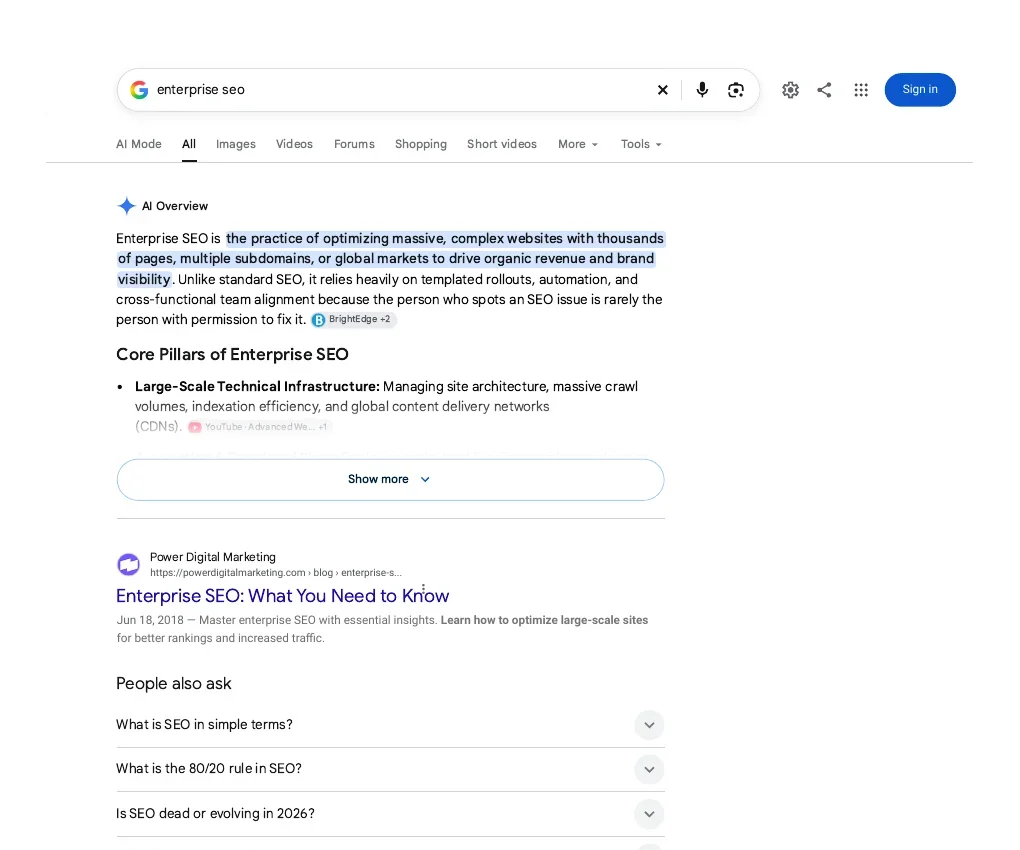
Small-business SEO is mostly a craft problem: a handful of pages, one decision-maker, and changes that go live the same week. Enterprise SEO is mostly a systems problem. The site is template-driven, so one template change affects thousands of pages at once. Decisions pass through brand, legal, product, and engineering teams, each with its own priorities. And the site itself keeps growing — new products, new locations, new languages — faster than any one person can review it.
That changes what “doing SEO” means. On a small site, the specialist edits pages directly. On a large site, the specialist writes the rules, the templates, and the checks, and the pages follow.
The first scale problem is templates. On a large site, pages are generated from templates and databases, not written one by one. A single flawed template repeats across every page it generates. Fixing the template fixes thousands of pages at once, so enterprise SEO work starts with templates, not individual pages.
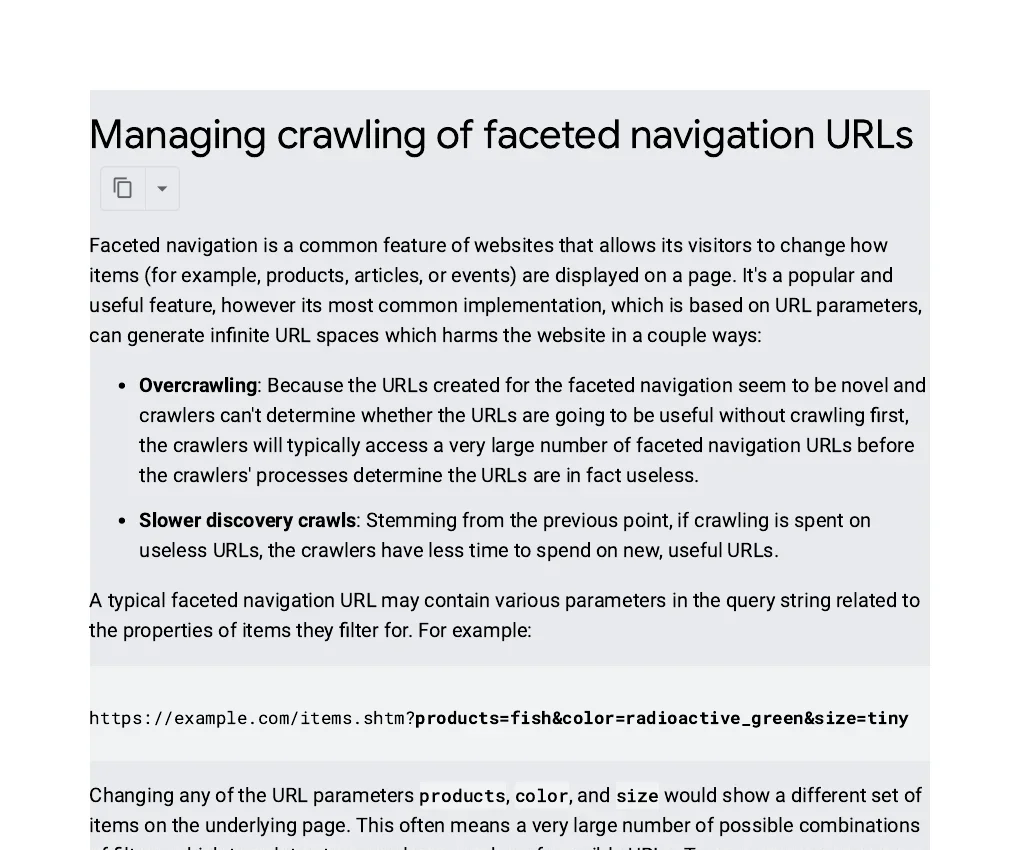
The second is faceted navigation: filters for size, colour, price, and brand can generate millions of near-identical URLs from a modest catalogue. Left unmanaged, those URLs swallow crawl budget — the limited attention search engines give your site — and dilute the pages that actually matter. The fix is a set of rules: which filter combinations get indexed, which get canonicalised, and which get blocked entirely. Those rules must be agreed with product and engineering, because they touch the shopping experience, not just SEO.
The third is crawl budget itself. On a very large site, search engines prioritise, and the pages that matter — new products, key categories, important content — can wait weeks if the crawl is wasted on duplicates, expired pages, and parameter URLs. Monitoring what actually gets crawled, and pruning what should not be, is ongoing work, not a one-off audit.
On a large site, nothing ships without approval, and SEO changes are no exception. A title-tag change that a small business makes in an afternoon may need sign-off from brand (wording), legal (claims), and product (accuracy) at an enterprise.
Good enterprise governance builds SEO into the approval process rather than bolting it on afterwards. That means agreed rules for page titles, descriptions, and headings; a checklist for new page types before launch; and a named owner for SEO decisions when teams disagree.
Legal deserves its own note. Regulated industries — finance, healthcare, pharmaceuticals — carry claims rules that shape what pages can say and must disclose. An enterprise seo solution in those sectors has to work inside those rules, and the SEO team needs a working relationship with legal, not an adversarial one.
Enterprise SEO rarely sits in one team. Content sits with marketing, templates with engineering, product data with merchandising, and local pages with regional teams. When those teams move at different speeds, SEO breaks in the gaps: a new range launches with no indexable pages, a migration ships without redirects, a regional team publishes duplicate content in three languages.
Coordination is therefore a core enterprise skill, and it is mostly unglamorous: shared roadmaps, launch checklists, and a single source of truth for URL structure and hreflang rules. For international sites, consistent rules for language and regional versions matter most — which version serves which market, how they link to each other, and what happens when a version does not exist for a market. For the technical foundations that underpin all of this, see the technical SEO guide.
Small-site reporting fits on one page: rankings, traffic, enquiries. Enterprise reporting has to answer different questions, for different audiences. Executives want revenue impact and trend direction. Product teams want to know which templates and categories are underperforming. Regional teams want their own markets, not a global average that hides them.
That means reporting by segment — by template, by category, by country, by page type — rather than one site-wide number.
It also means agreeing what success looks like before the work starts: a programme measured only on rankings will optimise for rankings; one measured on revenue, conversion, and indexed coverage will optimise for the business. An SEO audit is the usual starting point for setting those baselines, because it shows where the site stands across all segments before anything changes.
Choosing an enterprise SEO solution provider is different from choosing a small-business agency, and the questions should reflect that.
First, ask about scale experience specifically: sites of your size, in your sector, with your template and platform constraints. A provider whose largest client has five hundred pages has not solved your problems.
Second, ask how it works with your internal teams. Does it write rules and checklists your engineers can implement, or does it expect direct access to everything? Does it treat your governance as a process to strengthen, or as an obstacle? The right provider strengthens your internal process; the wrong one works around it and leaves nothing behind when the contract ends.
Third, ask what it measures and how it reports. Segmented reporting by template, category, and market should be standard, not an extra, and a sample report should name causes and actions, not just charts.
Fourth, ask about content at scale. Enterprise content is rarely written page by page; it is planned around templates, data, and genuine search demand, with quality checks before publication. A content strategy built for scale looks very different from a small-site editorial calendar.
Finally, check the exit. You should own your data, your rules, your templates, and your documentation. Our enterprise SEO services page sets out the service itself, and the contact page is where a first conversation begins.
Q: How is enterprise SEO different from regular SEO?
A: Scale and coordination: template-driven pages, millions of URLs, crawl budget management, multi-team approvals, and international rules — problems small sites never face.
Q: What is the biggest technical problem on large sites?
A: Crawl waste: faceted navigation, duplicates, and expired pages consuming the crawl that key pages need. Template fixes and indexation rules matter more than individual page edits.
Q: Does enterprise SEO need legal and brand approval for every change?
A: Not every change, but the rules do: agreed templates, title and description standards, and launch checklists mean routine work ships without a fresh negotiation each time.
Q: How should enterprise SEO be measured?
A: By segment — template, category, country, page type — and by business outcomes: revenue, conversions, and indexed coverage, not just rankings or site-wide traffic.
Q: What should I ask an enterprise SEO solution provider?
A: Scale experience in your sector, how it works with your internal teams and governance, whether its reporting is segmented, how it handles content at scale, and whether you own the playbook when the contract ends.

Muhammad Haris is the Founder of Onyx Growth Labs — an SEO specialist, content writer and SEO team lead. He writes the agency's guides on SEO, AI search optimisation, GEO and AEO, technical SEO, local SEO, Google Business Profile optimisation, link building and content strategy. Based in Abbottabad, Pakistan, he helps businesses worldwide get found on Google and in AI search answers.
If you run a small business on a limited marketing budget, the social media vs seo question comes up fast: social posts…
Read articleIf you have started checking whether your business appears in AI answers, you have probably found a new problem: a growing number…
Read articleIf you have ever received an SEO report with a number labelled domain authority, you may have wondered what that number actually…
Read article


Leave a Reply