0:00
0:00
Speed
 By Muhammad Haris · November 16, 2026 · 27 min read
A client asks for your domain authority before they will buy a link. An agency quotes a price per DA point. A competitor brags about a DA of 62. The number sounds like a grade, and it is treated like one — but it is not a grade Google gives. The domain authority meaning is simple once you know who makes the score: it is Moz’s estimate of how likely a website is to rank, built almost entirely from the links pointing at it, on a scale from 1 to 100. Google does not use it, Google does not publish it, and Google has said so plainly. This guide explains what the score measures, how Moz calculates it, how it compares with Ahrefs Domain Rating, Semrush Authority Score and Google’s own PageRank, what counts as a good score, how the number gets gamed, and how to use it without being misled. If the terms in this guide are new to you, start with our guide on what is SEO and come back.
One honest warning before you start: no tool can tell you how Google ranks your site, because Google does not publish its ranking scores. Domain authority is a prediction made by one company from its own crawl of the web. It is useful for comparing sites and for vetting link sellers, and it is useless as a target on its own. A site can raise its DA without ranking better, and a site can rank well with a low DA.
Domain authority is a score from 1 to 100 created by Moz that predicts how likely a website is to rank in search results compared with other sites. Moz builds it mainly from backlink data: how many different websites link to the domain, how strong those linking sites are, and whether the link pattern looks natural or spammy. The score applies to a whole domain or subdomain. Its page-level sibling is Page Authority, which applies the same idea to a single URL.
Three facts define the score, and they come straight from Moz’s Domain Authority explainer. First, it is a prediction, not a measurement: it estimates ranking ability and does not measure traffic, revenue or rankings directly. Second, it is relative — a score only means something next to the scores of the sites you compete with. Third, it is not a Google ranking factor. Moz says so in its own words: “Domain Authority is not a Google ranking factor and has no effect on the SERPs.” You may also see the term typed as “domine authority” — a common misspelling that shows up in search data — but the score it points to is always Moz’s.
The scale runs from 1 to 100, but the points are not evenly spaced. The scale is logarithmic, which means each point is harder to earn the higher you go. Moving from 20 to 30 is far easier than moving from 70 to 80, because the sites at the top of the scale hold vastly more and stronger links. A new site starts at 1. A site like Wikipedia sits near the top. Most working business sites live somewhere between 10 and 50, and that range tells you nothing on its own — it only matters against the sites ranking for the keywords you want.
Domain authority exists because buyers and sellers needed a shared number. Before it, a link seller could claim any site was “authoritative” and a buyer had no way to check. Moz gave the market a single number to argue about, and the market adopted it. That is the score’s real job: a common language for comparing link profiles. The rest of this guide takes the score apart so you can use the language without believing the myths.
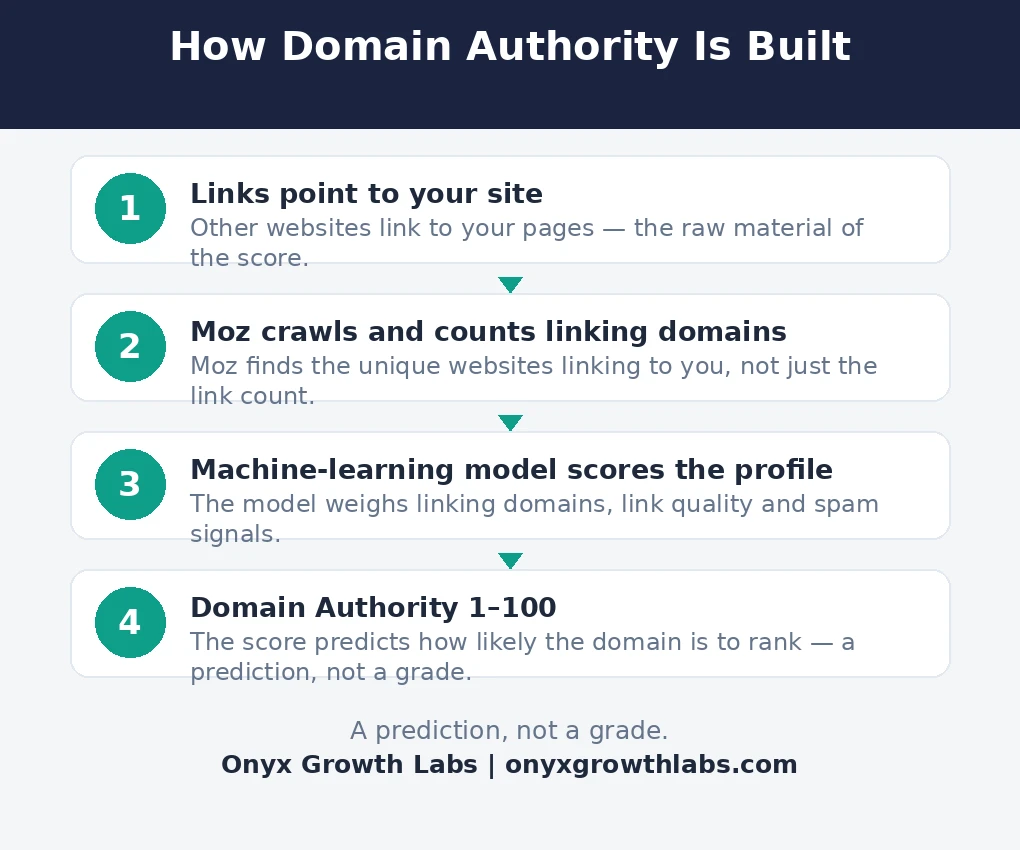
Moz calculates domain authority with a machine learning algorithm that works mainly from the backlink data in its own link index. The index behind the score holds over 44 trillion links, and Moz’s crawler keeps finding new ones every day. The model looks at dozens of link signals, and three carry the most weight: the number of linking root domains, the quality of those links, and spam signals that suggest manipulation.
Linking root domains matter more than raw link counts. A linking root domain is one unique website that links to you. A hundred links from one website count as one linking root domain; a hundred links from a hundred different websites count as a hundred. Moz and Google both value a diverse link profile, because links from many different sites are harder to fake than links from one. A site with 500 links from 5 domains has a weaker profile than a site with 200 links from 150 domains, and the score reflects that.
Link quality is the second input. A link from a well-linked, trusted site counts for far more than a link from a new site with no links of its own. The model is trained against real Google results, so it learns which link patterns tend to go with better rankings and weights those patterns more heavily. That training is what makes domain authority a prediction rather than a count: the score is the model’s answer to the question “how likely is this domain to outrank others?” rather than a tally of links.
Spam signals are the third input, and they arrived with Domain Authority 2.0, the rebuild Moz rolled out in March 2019. The new model moved from linear regression to a neural network, added Moz’s Spam Score to judge link quality, and started devaluing link patterns that did not lead to better rankings. Spam Score is a separate Moz score built on 27 features, and it feeds the DA model as a warning flag: a profile full of the patterns spammers use gets held back even if the raw link count is high.
Notice what is not in the formula: your organic traffic, your content quality, your page speed, or your conversion rate. Domain authority is a link metric with a machine learning model on top. A site with brilliant content and no links scores low, and a site with thin content and strong links scores high. That gap is the most important thing to understand about the number. Our guide on what is technical SEO covers the foundations the score ignores, and the two together give a fuller picture than either one alone.
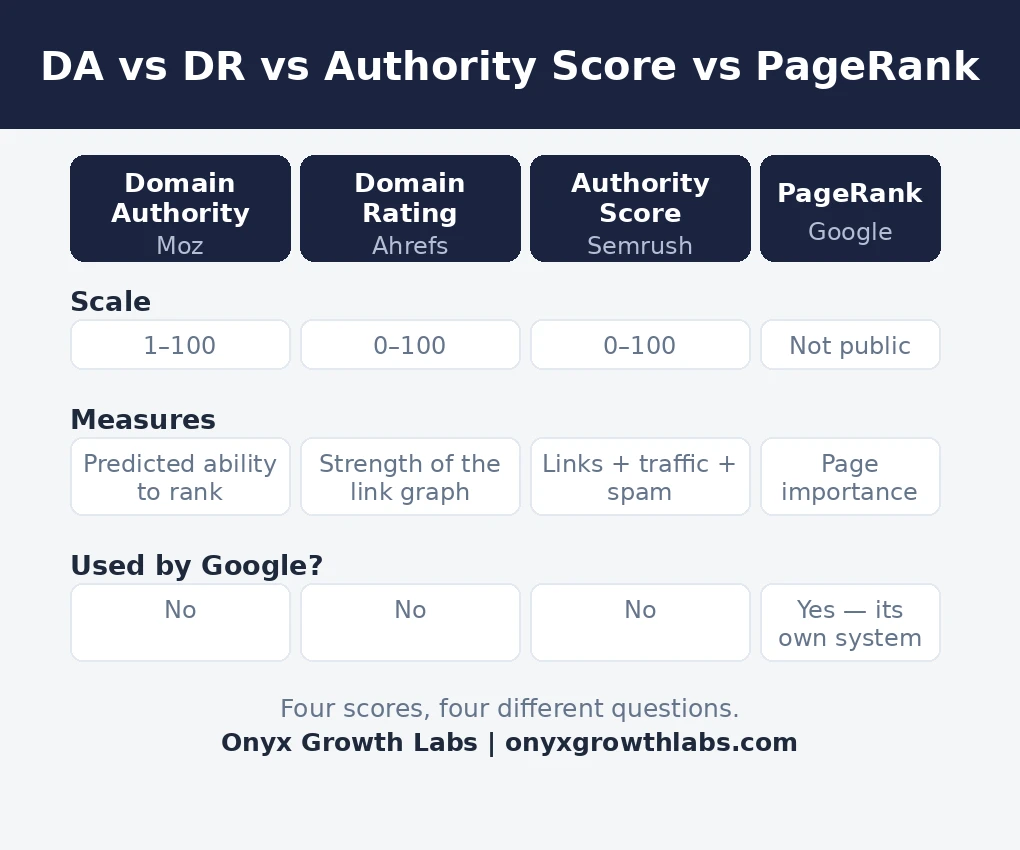
Four scores get confused with each other, and they are not the same thing. Moz’s Domain Authority, Ahrefs’ Domain Rating, Semrush’s Authority Score and Google’s PageRank all run on a 0-to-100 scale and all involve links — but only PageRank is Google’s own system, and it works differently from the other three.
Domain Rating is Ahrefs’ measure of the relative strength of a website’s backlink profile, on a logarithmic 0 to 100 scale. Ahrefs’ Domain Rating guide describes the calculation in three steps: count the unique domains that send the site at least one followed link, weight each linking domain by its own Domain Rating, and split the value by how many other sites each linking domain links to. Domain Rating is a pure link-graph score. It ignores traffic, spam signals, domain age and anchor text. It counts followed links only, so nofollow links add nothing to it, while Moz gives nofollow links partial credit in domain authority.
Authority Score is Semrush’s compound metric, and it blends three things the other two scores ignore. Semrush’s Authority Score guide explains that the score combines link power, organic traffic and spam factors across eight weighted factors, on a scale from 0 to 100, and updates every two weeks. Link power is the quantity and quality of dofollow backlinks. Organic traffic is the estimated monthly search traffic a site receives. The remaining six factors are spam checks: no organic rankings, an unnaturally high share of dofollow domains, an imbalance between links and traffic, too many referring domains sharing one IP address or one IP network, and a domain with an identical backlink profile. Because it includes traffic, Authority Score punishes a site with strong links and no visitors, which is exactly the pattern a link farm produces.
PageRank is the odd one out, because it is Google’s own system and it works at the page level, not the domain level. Google’s ranking systems guide lists link analysis systems and PageRank among the systems in use, and says PageRank is one of the core ranking systems Google used when it first launched, though how it works has evolved a lot since. The public PageRank toolbar was retired in 2016, so no one outside Google can see a PageRank score any more, and any “PageRank checker” that shows a 0-to-10 score is showing its own estimate or old data. The original idea still matters: a page’s importance is split among the pages it links to, so a link from a strong page that links to few others passes more value than a link from a page that links to hundreds.
The practical difference shows up when you check the same site in two tools. Our own site, Onyx Growth Labs, scores DA 1 on Moz and DR 22 on Ahrefs. The same domain, two very different numbers, because the two companies crawl different parts of the web with different bots, count different links, and measure different things. Neither number is wrong. They are answers to different questions: domain authority asks “how likely is this domain to rank?”, Domain Rating asks “how strong is this domain’s link graph?”, Authority Score asks “how strong is this domain’s link graph, traffic and spam profile combined?”, and PageRank asks “how important is this page, according to Google’s own link graph?” Compare scores only within the same tool, and never compare a DA with a DR as if they were the same unit.
Moz publishes no official bands for what counts as a good domain authority score, and any guide that quotes them as Moz’s own ranges is inventing them. The bands most guides use are a rough consensus, not a standard: under 20 is a new or low-authority site, 20 to 40 is below average, 40 to 50 is average, 50 to 60 is good, 60 to 80 is strong, and 80 and above is exceptional. Treat those bands as orientation, not as grades: a DA of 35 is good if every competitor sits at 25, and weak if they sit at 55.
The honest way to read the score is comparative. Check the domain authority of the sites that rank on page one for your target queries and of your direct competitors, then read your own score against that set. If the top ten results for your money keyword all sit between 45 and 60 and you sit at 20, you have a link gap to close before content alone will move you. If the top ten sit between 15 and 30 and you sit at 35, links are probably not your bottleneck, and the work that will move you is elsewhere — content, technical fixes, or relevance. Our guide on how to do an SEO audit walks through that kind of check applied to a whole site, and the competitor comparison is where the audit starts.
The score also has to be read against the niche. A local plumber competes with other local plumbers, and a DA of 25 can dominate a local market. A national finance site competes with banks and publishers, and a DA of 55 can still lose. Large organizations face the same logic at a bigger scale: our guide on enterprise SEO services covers what large organizations actually need when the competitive set is national or global, and the authority gap is only one part of that picture. The niche sets the bar, not the number.
One more caution: domain authority is domain-wide, and rankings are page-level. A DA 30 site can outrank a DA 60 site for a specific query, because the DA 30 site has the better page for that query. The domain score predicts the average outcome across many keywords, not any single page.
The myths around domain authority cause more wasted money than the score itself. Five of them come up again and again, and each one is worth killing plainly.
First, domain authority is not a Google ranking factor. Moz says so, Google says so, and the score is built from Moz’s crawl, not Google’s data. Raising your DA does not raise your rankings by itself; it raises a number that correlates with rankings because both are driven by links. The work that raises DA — earning good links — is the same work that raises rankings, but the number is a side effect, not the cause.
Second, domain authority is not a measure of traffic. A site can have a DA of 50 and almost no visitors, because the score counts links, not people. One large study of more than 40,000 websites found the correlation between Moz DA and traffic was only 0.23 — a weak link. A high-DA site with no traffic is usually a site that bought links or inherited them from an old domain, and it is a warning sign, not a success.
Third, domain authority is not a measure of content quality, trust, or expertise. It does not read your articles, check your facts, or know whether your business is real. A site full of spun content can score high on links alone, and a site with careful, original work can score low for want of links. Google’s quality signals and Moz’s link model measure different things, and neither one substitutes for the other.
Fourth, domain authority is not a guarantee of anything. No score promises a ranking, a click, or a sale. A DA 70 site still loses queries to better pages, and a DA 20 site still wins queries where its page is the best answer. The score is a probability across many keywords, not a promise about any one of them.
Fifth, domain authority is not the same as Domain Rating, Authority Score, or PageRank. Each tool measures something different with different data, and the numbers are not interchangeable. A link seller who quotes “DA 50” without saying which tool produced the number is hiding something, because the same site can show DA 25 and DR 45 on the same day. Ask which tool, and ask for the traffic alongside it.
Domain authority moves without you doing anything, and that movement confuses owners who expect a stable number. Moz’s help pages explain the cadence: the index that powers Link Explorer is constantly updating with fresh link data, but DA and PA change only when Moz finds new links to a site. Four things move the score on their own.
First, Moz’s crawl finds more or fewer of your linking domains than last time. The web changes constantly, and Moz’s crawler does not see every link on every pass. A linking site goes down, a page gets deleted, a link gets removed, and the next crawl counts fewer domains. The score falls, and nothing about your site changed. The reverse happens too: a crawler pass that discovers links it missed before pushes the score up without any new work from you.
Second, the scale is relative, so other sites’ gains move your score. Domain authority is trained on how sites rank against each other, and the 1-to-100 scale is fitted to the whole index. When your competitors earn strong links, the bar rises, and your unchanged profile scores lower against it. A falling DA can mean your competitors improved, not that you got worse. That is why the score should always be read next to the competitors’ scores, not alone.
Third, Moz updates the model. The DA 2.0 rebuild in March 2019 moved many sites’ scores at once, because the new model weighed spam signals and link quality differently. Smaller model updates since then have done the same on a smaller scale. A sudden move across many sites at once usually means Moz changed the maths, not that every site changed its links.
Fourth, links get lost. Sites close, pages get redesigned, and old links disappear. Link loss is normal, and a site that earns no new links will slowly drift down as old ones die. That drift is why link building is maintenance as well as growth. Check the score monthly against the same competitors, and judge the three-month trend, not a single week. Our guide on how often should you do an SEO audit sets out how often the full check runs, and the authority comparison sits inside it.
There is no button that raises domain authority, because there is no direct input for it. The only way up is to improve the link profile the model reads: more linking root domains, better linking sites, and a cleaner spam profile. The work is link building, and it takes months, not weeks. Anyone who promises a DA jump in thirty days is selling links you should not buy.
Start with the content worth linking to. A buying guide that compares the five best products in a category, a test that measures what manufacturers claim, a data page that answers a question nobody else has answered, or a free tool that solves a small problem — these are the pages other sites link to without being asked. A site that publishes nothing worth citing has nothing to earn links with, and no outreach email fixes that. The best way to organize that content is a topic clusters content plan: one central guide, with the pages around it answering the smaller questions, all linked to each other.
Then earn the links. Digital PR earns links from news and trade media by giving journalists something new: a survey, a dataset, a local angle. Broken link building earns links by finding dead links on relevant sites and offering your page as the replacement. Resource-page outreach earns links from pages that already collect the best guides on a topic. Supplier, partner and customer pages earn links from businesses you already work with. Our guide on what is link building explains how that half works, and the white-hat link building guide shows what the honest version of that work looks like in practice, and the difference between buying links and earning them.
Fix the technical foundation at the same time, because links to pages Google cannot crawl are wasted. Our technical SEO checklist covers the same crawl and index checks you should run first: if Google cannot crawl the pages the links point to, the authority has nowhere to land. Add the same discipline to the pages themselves — our guide on on-page SEO services covers what a full service does page by page, and our Schema Markup Guide covers the exact fields and the mistakes to avoid — and to the site’s structure, because internal links distribute the authority the external links bring in. A strong page three clicks from the homepage with no internal links pointing at it is a page the site itself does not believe in. If the store sells in several countries, the same discipline applies per market: the international SEO hreflang guide covers the language half, and our International SEO Consultant guide covers the multi-market setup around it. If you run a store, our guide on WooCommerce SEO services covers the same checks for WooCommerce stores.
Clean up the spam profile last. Remove or disavow links from obvious link farms, hacked sites and irrelevant directories, but do it as a cleanup, not as the main strategy. Disavowing is a last resort for links you cannot get removed, and Google says most sites never need it. A small number of bad links will not sink a profile with hundreds of good ones. The order matters: earn good links first, clean up second. A profile that only removes bad links and earns nothing new stays exactly where it is.
Set expectations in months. New links take weeks to be found by Moz’s crawler, and the score moves only when the index updates. A realistic timeline is three to six months before a sustained link programme shows up as a higher DA, and longer in competitive niches. Judge the work by the links earned and the rankings that follow, not by the number alone.
Domain authority is a useful tool for three jobs: comparing competitors, vetting link sellers, and tracking a link programme over time. It is a bad tool for everything else.
Comparing competitors is the first job. Before you target a keyword, check the domain authority of the sites on page one. If they cluster between 20 and 35 and you sit at 30, the keyword is winnable on content and relevance. If they cluster between 60 and 80 and you sit at 15, the keyword needs a link programme first, and the content can wait. That comparison is the cheapest strategic decision in SEO: it tells you where to spend and where not to. Our local SEO checklist covers the same ground as a list you can work through in order when the competitors are local, and our guide on how to rank higher on Google Maps covers the same steps from the Maps side.
Vetting link sellers is the second job. Before you pay for a link, check three numbers, not one: the seller’s domain authority, the site’s organic traffic, and its Spam Score. A site with DA 55 and almost no organic traffic is a red flag — it has links but no audience, which is the pattern of a site built to sell links. A site with DA 30 and steady traffic from real keywords is usually a better buy than a DA 60 site with none. Check the traffic trend too: a site whose traffic fell off a cliff after a Google update may be carrying a penalty, and a link from it carries the risk with it.
Tracking a programme is the third job. Record your DA and your top five competitors’ DA on the first of every month, in the same tool, and watch the gap, not the absolute number. A gap that narrows by two points a quarter is real progress. A single point up or down in a month is noise. The same discipline applies to the other scores: track DR and Authority Score alongside DA, and you will see when the tools agree and when they disagree — and disagreement is information, because it tells you which part of the profile is moving.
What not to do with the score is just as important. Do not set a DA target in a client contract, because you cannot control Moz’s model, its crawl, or your competitors’ links. Do not buy links by DA alone, because a high DA with no traffic and a bad spam profile is a liability. And do not report DA as a result to a client who asked for rankings or revenue — report the rankings and the revenue, and mention DA only as the context behind them.
Domain authority is a link metric, so anything that piles up links can push it up without making the site any more useful. The gaming methods are well known, and so are the signs.
The oldest method is the link farm: a network of sites built only to link to each other and to paying customers. The sites have thin content, no real audience, and hundreds of outgoing links. They pass DA because the model counts links, and they fail every other check because they have no traffic, no brand, and no reason to exist. Google’s spam policies treat buying or selling links that pass ranking credit as spam, and a site caught in a farm risks a manual action, not just a wasted fee.
The second method is the expired domain. An old domain with a strong link profile expires, someone buys it, and the links it earned years ago keep counting. The new site inherits a DA it did nothing to earn, and sells links at a price the number justifies. The signs are a mismatch: a domain registered recently with a high DA, content that has nothing to do with the sites linking to it, and traffic near zero. Check the domain’s history and its traffic before you trust the number.
The third method is the private blog network, a set of sites owned by one operator that link to client sites. The sites look independent — different hosts, different designs, different names — but they share footprints: the same IP ranges, the same analytics accounts, the same link patterns, the same thin content. Authority Score’s spam checks were built for exactly this pattern, and one of its eight factors is the presence of another domain with an identical backlink profile. If two sites share nearly all their linking domains, one of them is probably not independent.
The fourth method is buying links from high-DA sites that sell them openly. The link itself is real, but the site selling it has no editorial standards, and Google’s systems are built to discount exactly that kind of link. The buyer gets a DA bump and no ranking improvement: money spent, number up, business unchanged.
Spotting a gamed score takes three checks. First, traffic: a high DA with near-zero organic traffic is the single biggest red flag. Second, relevance: links from sites in unrelated niches or other languages, with no connection to the site’s topic. Third, the link pattern: hundreds of links from a small set of domains, or links that all appeared at once. Run all three checks before you pay for a link, and run them on your own site too.
Website authority is the broader idea behind all of these scores: an estimate of a website’s SEO strength and influence on the open web, based mostly on its backlink profile — how many other websites link to it and how trusted those sites are. It is not an official metric used by Google, AI search platforms, or other search engines. Different SEO tools calculate it in different ways, and each tool gives its version a different name.
Moz calls its version Domain Authority. Ahrefs calls its version Domain Rating. Semrush calls its version Authority Score. Majestic, the oldest link index of the four, splits the idea into two numbers: Trust Flow for link quality and Citation Flow for link quantity. A site can have high Citation Flow and low Trust Flow — many links from weak sites, the same warning sign as a high DA with no traffic.
The phrase “website authority” is also what buyers usually mean when they ask the question. They want to know whether a site is strong, trusted, and worth a link or a mention. No single number answers that, because strength, trust and worth are different things. The honest answer to “what is website authority” is that it is a family of estimates, each built from one company’s crawl, and the useful version is the one you check alongside traffic, relevance and spam signals — never the number alone.
Checking a domain authority score costs nothing to start with. Moz’s Link Explorer works with a free Moz Community account, which gives 10 Link Explorer queries a month with no card required, and the MozBar browser toolbar shows DA, Page Authority and Spam Score free on any page you visit. Ahrefs’ free Webmaster Tools works on unlimited verified websites and shows backlink data for sites you own. Semrush’s free account gives a small daily allowance of reports, including Authority Score. For occasional checks, the free tier of one tool is enough.
Paying starts when you need volume, history, or reporting. Moz Pro’s pricing runs from $49 a month for Starter, which covers one site, to $99 a month for Standard, $179 for Medium and $299 for Large on monthly billing, with about 20% off when you pay yearly. The limits rise with the price: Starter tracks 50 keywords and allows 75 backlink queries a month, while Large tracks 3,000 keywords and allows 70,000 backlink queries. Extra users cost $49 a month each on any plan.
Ahrefs’ pricing starts higher: Lite at $129 a month, Standard at $249 and Advanced at $449, with a free tier for verified sites but no free lookups of other people’s domains. Semrush Pro starts at around $139 a month, with a free account that allows a small number of reports a day. The cheapest honest plan is the free tier of the tool whose score you actually need to quote: Moz for DA, Ahrefs for DR, Semrush for Authority Score. Paying for all three makes sense only if you vet links or report to clients every week. Our guide on how much does SEO cost covers what help costs when you decide to hire it, and the same questions apply here.
Whether you are talking to an SEO services in Lahore provider, a digital marketing agency in Riyadh, or a team that handles SEO Services in the UK, the questions, the audit and the checks are the same. Geography changes the price. It does not change the work. And if you decide to hire instead of doing it yourself, our guide on how to choose an SEO agency covers the questions to ask any service before you sign.
AI search does not read domain authority. When a user asks ChatGPT, Gemini or Perplexity a question, the answer is built from pages the system retrieves and trusts, and no authority score is part of that retrieval. A high DA does not make a page more likely to be cited, and a low DA does not keep a good page out. The score was built to predict Google rankings, and AI answers are a different system with different signals.
The evidence points the same way. A 2026 study by Outrank of 200 sites found that sites with a Domain Rating of 30 or more earned 29 times the AI citations of sites under DR 10. But the same study found that Google impressions predicted AI citations far better than DR did: the sites Google already shows are the sites AI systems already cite. The link profile helps because it builds that visibility, not because any AI system reads the score.
What matters for AI answers instead is the page itself: complete specifications, real reviews, clear prices, named authors, primary sources, and content that answers the question directly. Our guide on how to get cited by AI covers the content half of that work in full, including how to shape a page so an engine can lift from it cleanly. Our comparison of GEO vs SEO vs AEO explains the same three layers in full, including which kind of work each one needs and where the budgets go. Our guide on how to track AI visibility covers how to set up measurement before you buy a tool, and the same discipline applies here: measure citations and impressions, not a third-party score.
The practical conclusion is simple: keep building links, because they still build the visibility that every system reads, but stop watching domain authority as if it were the goal. The goal is pages that rank in Google and get cited by AI answers. Domain authority is a rough gauge of the link half of that work. It was never the work itself.
Domain authority is Moz’s 1-to-100 prediction of how likely a website is to rank, built mainly from linking root domains, link quality and spam signals. It is not a Google ranking factor, not a measure of traffic or quality, and not interchangeable with Domain Rating, Authority Score or PageRank. Use it to compare competitors, vet link sellers and track a link programme over time — always next to traffic, relevance and spam signals, and always in the same tool. Raise it by earning links from diverse, trusted sites, and judge the work by the rankings and revenue that follow, not by the number alone. Your job is to build a link profile worth trusting, not a score worth quoting.
Domain authority is Moz’s score from 1 to 100 that predicts how likely a website is to rank in search results compared with other sites. It is built mainly from the links pointing at the domain: how many different websites link to it, how strong those sites are, and whether the link pattern looks natural. Google does not use it, and it is not a measure of traffic or content quality.
No. Moz says so directly: “Domain Authority is not a Google ranking factor and has no effect on the SERPs.” Google does not use it or any other third-party score to rank pages. The work that raises domain authority — earning good links — is the same work that raises rankings, but the number itself is a side effect, not the cause.
There is no official threshold, because Moz publishes no bands. The bands most guides use are under 20 for a new site, 20 to 40 below average, 40 to 50 average, 50 to 60 good, 60 to 80 strong, and 80 and above exceptional. The only honest reading is comparative: compare your score with the sites ranking on page one for your keywords and with your direct competitors.
Domain authority is Moz’s machine-learned prediction of ranking ability, trained on Google results and built from linking root domains, link quality and spam signals. Domain Rating is Ahrefs’ pure link-graph score: it counts unique domains sending followed links, weighted by their own Domain Rating. They use different crawlers and different maths, so the same site can show DA 25 and DR 45. Never compare a DA with a DR as if they were the same unit.
You can pay for the work that raises it — content, outreach, digital PR — but you cannot pay Moz to raise the number, and buying links to inflate it is against Google’s spam policies. Links bought from farms and networks can push the score up while adding no rankings, and they put the site at risk of a manual action. Earn links from real sites instead.
Four common reasons: Moz’s crawl found fewer of your linking domains than last time, your competitors earned strong links and the relative scale moved against you, Moz updated its model, or old links were lost as sites closed or pages were redesigned. Check the score monthly against the same competitors, and look at the three-month trend before you judge it.
Months, not weeks. New links take weeks to be found by Moz’s crawler, and the score moves only when the index updates. A realistic timeline is three to six months before a sustained link programme shows up as a higher score, and longer in competitive niches. Judge the work by the links earned and the rankings that follow, not by the number alone.
Not directly. AI answers are built from pages the system retrieves and trusts, and no authority score is part of that retrieval. Link strength still correlates with being cited, because the sites Google already shows are the sites AI systems already cite — but the score itself is not read by any AI system. What matters is the page: complete facts, real reviews, named authors and content that answers the question directly.

Muhammad Haris is the Founder of Onyx Growth Labs — an SEO specialist, content writer and SEO team lead. He writes the agency's guides on SEO, AI search optimisation, GEO and AEO, technical SEO, local SEO, Google Business Profile optimisation, link building and content strategy. Based in Abbottabad, Pakistan, he helps businesses worldwide get found on Google and in AI search answers.
If your customers speak more than one language, an English-only website is quietly turning some of them away. Multilingual SEO is the…
Read articleIf you run a business and you have ever uploaded a video, the questions you ask first are always the same: why…
Read articleIf you run a business in Sheffield, the questions you ask before hiring SEO help are always the same: what does it…
Read article


Leave a Reply