0:00
0:00
Speed
 By Muhammad Haris · November 12, 2026 · 27 min read
If you run a business in the UK and you are comparing agencies, the hardest part is not finding one — it is telling the good ones from the ones that will take your money and show you a ranking report. There are hundreds of agencies selling SEO services in the UK, with published prices ranging from £199 a month at the low end to £4,000 a month and more at the top end, and the work behind those two prices is not the same work. This guide explains what a good agency actually delivers, what it costs in pounds, and how to choose one without buying a promise.
Search Console records only a handful of queries for this page — “seo england” and “seo united kingdom”, three impressions each in the last 28 days, plus a Russian-language query and one piece of noise — so this guide is built from the search results, the named sources below, and the questions UK buyers actually ask. I run an SEO agency that serves clients worldwide, including in the UK, and the UK work has its own shape: the map pack matters more than it does in most markets, the prices are quoted in pounds with VAT on top, and the buyers are careful — they want the scope in writing before they pay.
This guide covers what seo services in the uk actually include in 2027: the technical core, local search, content, what it costs, how to vet an agency, what the monthly work looks like, AI search, link building, ecommerce and national campaigns, and the red flags that tell you to walk away.
SEO services in the UK are the managed programme that gets a British business found on Google: technical fixes, a Google Business Profile that actually works, local and national content, honest link building, and a monthly report you can read. The short version is that a good agency sells the work, not the ranking — the audit, the fixes shipped, the pages published, the links earned, and the report delivered on time.
The UK market has one feature that changes the buying decision: Google still carries the overwhelming share of UK search — about 91% of UK searches went through Google in June 2026, according to SEORankUK — so the whole job is really one job, getting found on Google, in the map pack, in the organic results, and now in the AI answers above them. A business that is invisible on Google in the UK is invisible, full stop.
The rest of this guide walks through each part in order: what the service actually means, local SEO, the technical core, content, cost, choosing an agency, the monthly work, AI search, links, ecommerce, and the red flags. The prices are in pounds and every figure is attributed to the agency or study that published it, so you can check it yourself.
One warning belongs up front. No honest provider guarantees rankings, traffic or revenue, because nobody controls Google. What a provider can guarantee is the work: the audit, the scope, the fixes shipped, the reports delivered on time. Judge the programme on the work, not on the promise — and if the price is so low the work cannot be in there, it is not in there.
The phrase covers four different jobs, and most buyers only need two of them. Local SEO gets a business into the Google Maps local pack and the AI answers for searches in its area: Business Profile, local pages, citations and reviews. National SEO gets a business ranking across the whole UK for the searches its customers use. Technical SEO fixes the website itself: speed, crawling, indexing, redirects and structured data. And content plus link building earns the authority that makes the other three stick. A good agency tells you which of the four you need before it quotes, and a bad one sells you all four whether you need them or not.
The first distinction to make is local versus national, because the work and the price are different. A plumber in Leeds needs the map pack, the reviews and a handful of local pages. A software company selling to the whole UK needs national content, technical depth and authority. The two programmes share the same foundations — if the words SEO are new to you, our guide on what is SEO explains the foundation first — but the monthly work, the reporting and the price are different, and an agency that quotes one flat price for both is not thinking about your business.
The second distinction is between a service and a result. An agency delivers services: audits, fixes, pages, links, reports. The results — rankings, calls, sales — follow from the services, but they follow on Google’s timetable, not the agency’s. A quote that lists services, hours and deliverables is a quote you can judge. A quote that lists rankings and revenue is a quote you cannot check until it is too late.
Wikipedia’s overview of search engine optimization defines it plainly as improving the quality and quantity of traffic to a website from search engines — and in the UK, the quality half is the hard half, because the market is crowded and the buyers are careful.
For most UK small businesses, local SEO is the whole job. When someone in Manchester searches for a plumber, a dentist or a solicitor, Google shows a map pack of three businesses before the organic results, and the businesses in that pack get the calls. Getting into the pack is a different discipline from ranking a web page, and it starts with the Google Business Profile.
The profile is the business’s listing on Google: name, address, phone number, categories, services, photos, posts, questions and answers, and reviews. The rules are simple and strict: one profile per location, the exact business name as it appears on the shopfront, the correct primary category, and the same name, address and phone number everywhere the business is listed. A profile with the wrong category, a keyword-stuffed name or an old phone number is a profile that loses the pack to a competitor that got the basics right. Google’s Business Profile help explains the setup and the rules, and it is the first document any local business should read.
Reviews are the second half of local SEO, and they are the half most businesses neglect. A profile with recent reviews, answered reviews and a steady flow of new ones outranks a profile with five old reviews, because Google reads reviews as evidence that the business is alive and trusted. The work is unglamorous: ask every happy customer, answer every review within a day or two, and never buy reviews — a bought review is a policy violation that can take the profile down.
Citations are the third half: the business listed on the directories and platforms UK customers actually check, with the same name, address and phone number in each one. The point is consistency, not volume — fifty listings that disagree about the phone number are worse than ten that agree. Our local SEO checklist walks through the full local setup, step by step, and our guide on how to rank higher on Google Maps covers the map pack in detail — the profile, the reviews, the citations, and the local pages that support them.
The local pages are the part agencies most often skip. A business that serves five towns needs a page for each town that says something real about that town — the areas covered, the local work done, the local reviews — not five copies of the same page with the town name swapped. Google reads a swapped-name page as thin content, and a thin local page does not rank. The same rule applies to the whole site: one page per place, with real local facts on it.
People find this page by searching for “seo england” and “seo united kingdom”, and the reason is simple: England is where most of the UK’s businesses and searches are. But the UK is four nations, and a business in Edinburgh, Cardiff or Belfast faces the same map pack with different local competitors — the discipline is identical, only the place names change.
Technical SEO is the foundation under everything else, and on a UK site it is usually where the money is wasted first. A site that Google cannot crawl, cannot index, or cannot render quickly will not rank no matter how good the content is, and the fixes are the same whether the business is in London or Leeds. The technical SEO layer covers crawlability, indexation, rendering, speed and mobile behaviour across every template, and the audit that finds the problems has to be read the same way. Our guide on how to do an SEO audit separates technical problems from content and authority ones — the audit tells you which half of the work your site needs first.
The order of the work matters more than the list. First, make sure the important pages can be crawled and indexed at all. Second, fix the errors that repeat across the site: broken canonicals, blocked resources, sitemap errors, duplicate pages, redirect chains. Third, fix speed, because a slow site loses visitors before it loses rankings — Core Web Vitals are the measure, and the fixes are usually server-side rendering, image delivery and third-party script management. Fourth, measure again, because a technical fix that is not measured is a guess.
Google’s SEO starter guide is the baseline every UK team should have read: it covers how Google finds, indexes and ranks pages, and most technical debt is a violation of something in that guide, repeated across a template. The guide is written for beginners, which is exactly why it is useful — if a page breaks the starter guide, the page is broken, and no amount of content will fix it.
One UK-specific technical point deserves a sentence: international structure. A business that sells into the UK from abroad, or a UK business that sells into Ireland or Europe, needs the right structure — subdirectories, subdomains or country domains — and hreflang that actually validates. A US site with a “/uk/” folder and no hreflang will rank the wrong page in the wrong country, and a UK site that serves the whole of Europe from one English page will rank for none of it properly. The structure decision belongs at the start of the programme, not after the content is written.
Content is where UK SEO is won or lost, because the UK market is crowded and the buyers are careful readers. A page that answers the buyer’s question directly, in the first lines, with the evidence in the same passage, will outrank a page that opens with a slogan. A page written for a keyword will not. The difference is visible in the first screen: the good page says what the business does, who it is for, and what it costs, before the fold. The bad page says “welcome to our website”.
The map starts with the searches customers actually use. Our guide on how to do keyword research walks through finding those searches, and grouping searches so each page targets one clear intent is the same discipline as keyword clustering — the point is not the biggest keyword list, it is intent. Our guide on what to do after keyword research turns that list into a plan, step by step: one page per intent, one owner per page, one review before publishing.
The standard is a set of rules every page follows: one question per page, the answer in the first lines, the evidence in the same passage, the facts checked against the same source. The review step is where the standard lives or dies. A page that ships without review is a page that can contradict the brand, repeat a competitor’s claim, or target a keyword another page already owns. The review does not have to be slow — a checklist and a named reviewer are enough — but it has to exist, and it has to apply to everyone, including the senior team.
Google’s guidance on creating helpful content rewards pages written for people, not for rankings — which, for a UK page, is the same test as ever: would a reader find anything on this page that is actually useful to them, or is it a page that only exists to hold a keyword? The guidance also asks publishers to evaluate content in terms of who wrote it, how it was made, and why — and a page that shows real experience, with real examples and real numbers, passes that test. Schema helps machines identify what the page is — Organization, Article, FAQ where relevant — but no single schema type creates a ranking on demand. The passage is the product; everything else is packaging.
One more UK point: spelling and language. A page written in American English for a UK audience reads as foreign, and a page that calls a solicitor a lawyer or a flat an apartment has told the reader it was not written for them. The fix is mechanical — a style sheet that lists the UK spellings and terms, applied to every page — but it is the kind of detail that separates a page written for the UK from a page translated for it.
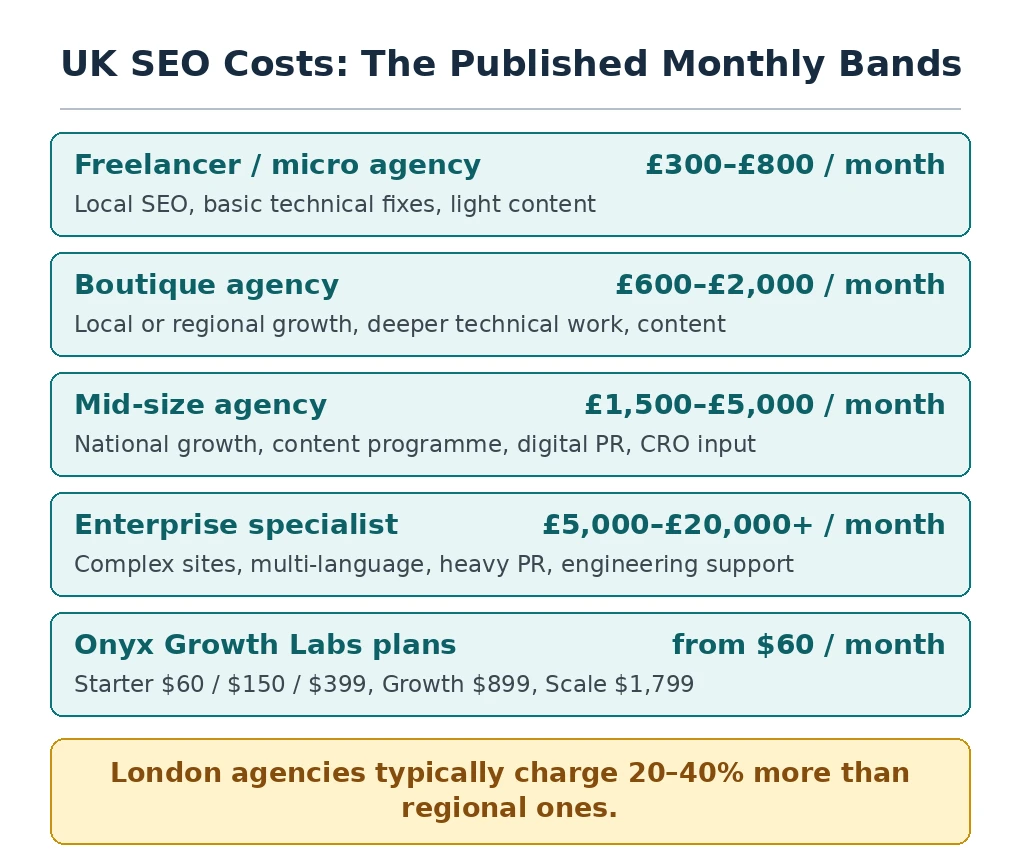
The honest answer is that UK SEO is priced by the provider and the scope, and the published ranges are wide enough that a single number is meaningless. The useful answer is the published bands, and they are consistent enough across the agencies that publish them to be worth quoting. Studio 36 Digital’s 2026 UK pricing guide puts monthly retainers at £300 to £800 for a freelancer or micro agency, £600 to £2,000 for a boutique agency, £1,500 to £5,000 for a mid-size agency, and £5,000 to £20,000 or more for an enterprise specialist. A technical audit runs £750 to £2,500 for a small to medium site and £2,500 to £7,500 or more for a large or complex one. A consultant or senior specialist charges £75 to £200 an hour, or £500 to £1,400 a day.
LOCALiQ, one of the larger UK agencies, publishes its own tiers: campaigns start from £1,300 a month, with Foundations at £1,300 to £2,000, Growth at £2,000 to £2,750, and Enterprise at £2,750 or more. True SEO publishes lower starting prices: £399 a month for local SEO and £699 a month for full service, with niche programmes from £1,495. SEOPages counted 89 of 351 UK providers that publish a monthly price at all — about one in four — and found the cheapest published plan under £300 a month for 35% of them, £300 to £799 for 46%, £800 to £1,999 for 13%, and £2,000 or more for 6%. The Skale list of top UK agencies shows the same spread at the top end: The SEO Works from £2,000 a month, Vixen Digital from £1,300, Pinnacle from £395, and Skale itself from £4,000.
Two things move the price more than anything else. The first is location: Red Eagle Tech’s 2026 guide says London agencies charge 20% to 40% more than regional equivalents for the same tier, and the Skale list bears that out — the London names sit at the top of the price range. The second is scope: a local campaign for one town costs a fraction of a national campaign across the whole UK, and an ecommerce site with ten thousand products costs a multiple of a brochure site with ten pages. Our guide on how much SEO costs covers the five factors in detail — scope, competition, site size and condition, who does it, and where they are — and the UK version is the same five factors, priced in pounds with VAT on top.
Our own plans start at $60 a month, with Small Business Starter plans at $60, $150, or $399 a month, Growth at $899, and Scale at $1,799. The point of quoting the UK bands beside our own prices is not to claim we are the cheapest — we are not, and the cheapest plan is rarely the right one — it is to show you the range, so a quote of £300 a month for national work reads as what it is: a price at which the work cannot be in there.
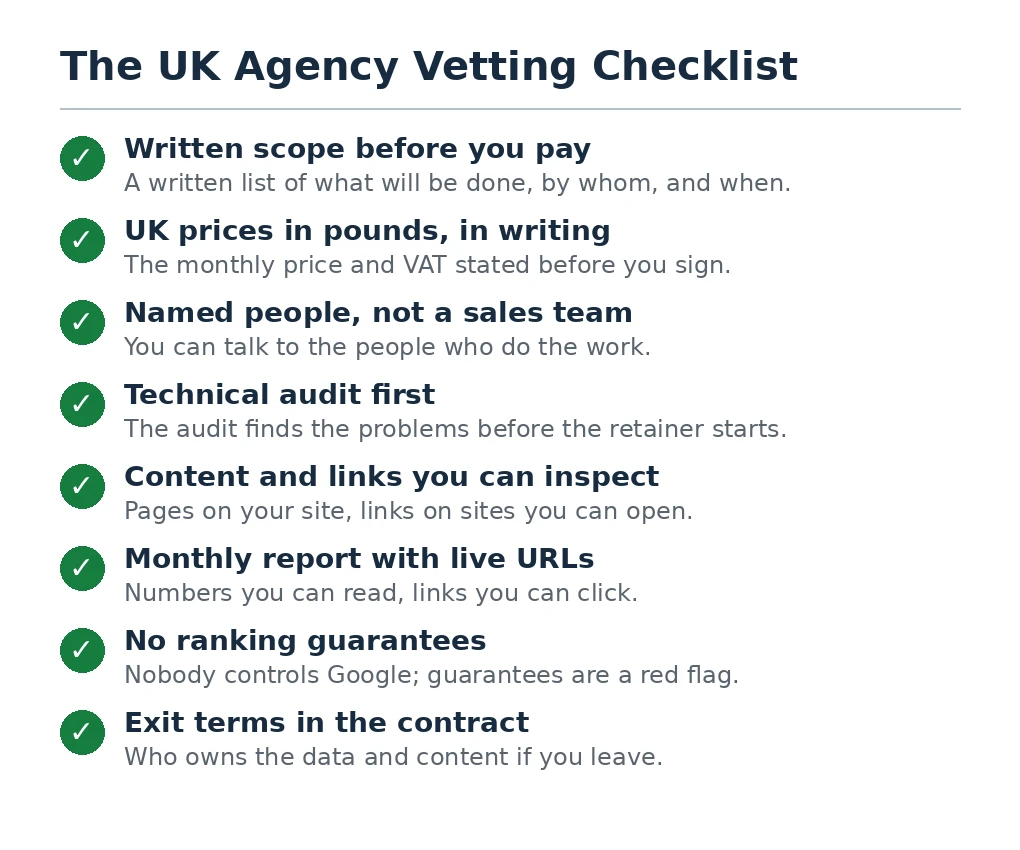
Choosing an agency is a procurement decision, not a marketing decision, and the vetting should look like one. Start with the scope: a written list of what will be done, by whom, on what schedule, with what reporting. A provider that cannot write the scope down cannot deliver it. Our guide on how to choose an SEO agency covers the same kind of vetting — the questions to ask, the written scope, the references to check — and the UK version adds three more: where the team sits, whether the prices are in pounds with VAT stated, and what happens when the engagement ends.
Google’s guidance on hiring an SEO lists the questions to ask and the red flags to watch for, and the biggest red flag is the same at every size: a guarantee. No provider controls Google, so a guaranteed ranking is a promise the provider cannot keep, and a provider that makes one will make others. The second red flag is a team you never meet: if the people who sell the work are not the people who do it, ask who does it, what they have done, and whether you can talk to them before signing.
References matter more than case studies. A case study is written by the provider; a reference is a client who will take a call. Ask for two, from businesses of a similar size and in a similar market, and ask them the same three questions: what was delivered, what was late, and what would they do differently. Then check the exit terms before you sign: who owns the data, the dashboards, the documentation and the content if the engagement ends. A programme you cannot leave is a programme you do not control.
The shortlist is a useful starting point, not a verdict. The seo.com 2026 UK rankings name The SEO Works, GenieCrawl, WebFX, Bird Marketing and Breakline among the top UK companies, and the GoodFirms and Manifest lists name many of the same firms. Use the lists to find candidates, then vet each one the same way: scope in writing, prices in pounds, named people, references, exit terms. The right agency for a plumber in Leeds is not the right agency for a software company selling nationally, and no list can make that choice for you.
Month one is diagnosis: the audit — technical, content, competitive — and the baseline, so month six can be compared with month one. The quick wins that need no approval get fixed first: broken canonicals, blocked resources, sitemap errors, the worst template problems. The reporting baseline is set up at the same time, and the cadence is agreed: weekly for the team, monthly for the business owner.
Months two and three are structure. The templates get fixed, starting with the ones that generate the most pages. The content standard gets written — one page per intent, one owner per page, one review before publishing — and the content inventory starts: what exists, what performs, what duplicates, what is missing. The local work runs in parallel: profile fixed, reviews flowing, citations corrected, local pages built with real local facts.
Months four to six are authority and proof. The first content built to the new standard ships, the earned-mention work starts on the sources the engines already trust, and the first monthly report runs against the baseline. The report should show movement in the technical health layer first — indexation, errors, speed — because that is the layer the team controls directly. The traffic and revenue story takes longer, and an honest report says so plainly: what moved, what did not, and what the next quarter will do about it.
The report itself is the test. Our guide to the SEO monthly report generator shows what a good monthly report looks like: live URLs you can click, numbers you can read, one sentence per change. If the report is a PDF of ranking positions with no links you can click and no explanation of what was done, it is not a report — it is a screenshot. And the cadence matters: our guide on how often should you do an SEO audit sets the rhythm for the first year — the audit is not a one-off, it is a standing job, repeated on a schedule the business can plan around.
AI search is now part of UK SEO, because British buyers already ask machines before they ask people. Google’s own guide, published in May 2026, says optimising for its AI features is still SEO — the same work, applied to a new surface. AI Overviews appear in a growing share of Google searches, and ChatGPT, Gemini and Perplexity answer a growing share of buying questions directly. The UK question is not whether to care — it is how to be the source the answer names.
The work is the same discipline as the rest of this guide, applied to a new surface. Retrievable pages first: indexable, crawlable, answer-first. Quotable passages second: one claim, one number or one step, with the evidence in the same passage, so a model can lift it whole. A recognizable entity third: the same name, description and facts everywhere the business is described. Honest third-party mentions fourth: reviews, forums, publications and comparisons the engines already trust. Our guide on how to get cited by AI covers the crawler rules and the citable-page method in detail, and our GEO vs SEO vs AEO comparison explains how the three relate, side by side.
Google’s AI features documentation states the rule plainly: to be shown as a supporting link in AI Overviews or AI Mode, a page must be indexed and eligible to be shown in Google Search with a snippet. There are no additional technical requirements, and no special optimization is required. You do not need to create new machine-readable files, AI text files or special schema to appear in these features. The work is ordinary search work: crawlable, answer-first, well linked, with nothing on the page that says noindex or nosnippet.
For a UK business, the AI layer also has a local side. A buyer who asks ChatGPT for the best plumber in Leeds gets an answer built from the sources the model trusts — reviews, directories, local pages, the Business Profile — and a business with no reviews, no citations and no local pages is a business the answer cannot name. The local work in the earlier section is therefore also the AI work: the same profile, the same reviews, the same citations, feeding a second surface. Measure it the same way, with a fixed set of prompts run monthly, so you know which sources the answers cite for your market.
Links are still the hardest part of UK SEO to buy well, because the UK market is full of packages that sell links by the dozen. A real link is an editorial mention on a real site that a real person reads — a local newspaper, a trade publication, a supplier’s site, a community page. A bought link is a placement on a site built to sell placements, and Google has spent twenty years getting better at telling the two apart. Our guide to what is link building explains what a real link is and what a bought one looks like, and our guide to off-page SEO services explains what real off-page work is and what the bulk packages are not — the short version is that a real link survives being looked at.
The UK work follows from that. Earn honest coverage on the sources UK buyers actually read: reviews on the platforms your buyers check, answers in the communities where your buyers ask, mentions in the publications your buyers trust. A review profile with real, recent reviews is an authority asset. A forum answer that solves a real problem is an authority asset. A comparison page on an independent UK site is an authority asset. None of them can be bought as a ranking — a paid placement that reads like an ad is ignored by the same systems that reward an honest mention.
Digital PR is the version of this that scales, and it is the service UK agencies most often sell badly. A real digital PR campaign creates something worth covering — a study, a dataset, a tool, a story — and earns coverage from it. A bad one sends the same press release to a hundred sites and calls the links that result “coverage”. The difference is visible in the coverage itself: the good campaign is cited by name in the article, the bad one is a link in a footer. Ask to see the coverage before you pay for the campaign, and judge the links by whether you would be proud to show them to a customer.
Ecommerce SEO in the UK is a different programme from local SEO, because the site is the shop. Category pages, product pages, filters, facets, and the thousands of URLs a catalogue generates are the whole job, and the template decides whether those pages are useful or thin. A category page with real products, real descriptions and real reviews is a page that can rank. A category page generated from a database with one swapped word is a thin page, and ten thousand thin pages are worse than ten good ones.
The rules are mechanical. Every category page answers a real question with real, specific facts: the range, the prices, the delivery terms, the reviews. Every product page carries the real specifications, not the manufacturer’s boilerplate copied word for word. Faceted navigation gets rules that keep the useful combinations and close the rest, because a filter that generates ten thousand URLs nobody searches for is ten thousand pages of crawl budget spent on nothing. And the internal linking follows the same rule as everywhere else: every new page gets links from the pages that already rank for its topic.
National SEO for a UK service business is the same discipline without the catalogue. The site serves the whole UK from one domain, so the structure is one set of service pages, one set of location pages for the towns that matter, and one content programme that answers the questions buyers ask nationwide. The location pages follow the same rule as the local section: one page per place, with real local facts on it, not five copies with the town name swapped. A national campaign that ignores the local pages will rank nationally and lose locally; a local campaign that ignores the national pages will rank locally and never grow.
The first red flag is a guarantee. No provider controls Google, so a guaranteed ranking, a guaranteed page-one position, or a guaranteed number of visitors is a promise the provider cannot keep. The agencies that make guarantees are the ones that buy the cheapest links, publish the thinnest content, and disappear when the rankings fall. A provider that guarantees the work — the audit, the scope, the fixes, the reports — is a provider you can hold to account. A provider that guarantees the result is a provider that has already spent your money.
The second red flag is a price so low the work cannot be in there. SEOPages found that 35% of UK providers that publish a price start under £300 a month, and the cheapest published plans cluster under £500. A £199-a-month plan can cover a profile check and a report, and it can do those two things well. It cannot cover a technical audit, content production, link building and reporting, because the hours do not exist at that price. If the quote is a fraction of the published bands in the costs section, ask what is not included — and then ask who does the work that is included.
The third red flag is secrecy. An agency that will not show you the links it built, the pages it published, or the changes it made to your site is an agency that does not want you to look. Every deliverable should be visible: the audit in a document you own, the pages on your site, the links on sites you can open, the report with live URLs you can click. If the only evidence is a ranking report the agency generated itself, there is no evidence.
The fourth red flag is the bought link. If the agency’s link report shows placements on sites you have never heard of, with names like “guest post” in the URL and no real readership, those links are bought, and bought links are the fastest way to a penalty that takes a year to clean up. Ask how each link was earned, and judge the answer by whether you would be proud to show the link to a customer. The same test applies to content: if the pages read as if they were written for a keyword rather than a customer, they were, and Google reads them the same way you do.
SEO services in the UK are not a mystery and not a trick. They are a programme: technical fixes, a Business Profile that works, local and national content, honest links, and a monthly report you can read — delivered by named people, priced in pounds, scoped in writing, and judged on the work shipped rather than the promise made. The market is crowded, the prices range from £199 a month to £4,000 and more, and the difference between the two ends is not luck — it is the hours, the skill and the honesty in the scope.
Our agency runs SEO the same way we run everything else — with the audit first, a written scope second, and the earned links third. Our content strategy service plans the topics and clusters, our link building services earn the authority, and our local SEO services handle the map pack and reviews for the offices and locations that need them. We also run full SEO audits of our own, with the same fix-first order this guide describes, and our white-label SEO services deliver the same work under your agency’s brand. The full plans are published on the site, and if you want to talk through your situation first, book a free consultation and we will tell you honestly whether you need us at all. You can also see what our work has delivered on our results page. Our plans start at $60 a month, with Small Business Starter plans at $60, $150, or $399 a month, Growth at $899, and Scale at $1,799 — and you can see the plans and prices on our pricing page. The buyer already asks the machine now. Answer it in one passage — and be the source it names.
Four jobs: local SEO (Google Business Profile, map pack, reviews, citations), national SEO (ranking across the whole UK), technical SEO (speed, crawling, indexing, redirects, structured data), and content plus link building to earn authority. A good agency tells you which of the four you need before it quotes, and a bad one sells you all four whether you need them or not.
Published UK bands for 2026 put a freelancer or micro agency at £300 to £800 a month, a boutique agency at £600 to £2,000, a mid-size agency at £1,500 to £5,000, and an enterprise specialist at £5,000 to £20,000 or more. A technical audit runs £750 to £2,500 for a small to medium site. London agencies typically charge 20% to 40% more than regional equivalents for the same tier.
Technical quick wins can land in 4 to 8 weeks, content and authority results typically take 3 to 6 months, and full ROI with revenue attribution usually takes 6 to 12 months. The technical fixes land first, the content and authority work compounds next, and the revenue story takes a year to prove.
Local SEO gets a business into the Google Maps local pack for searches in its area — profile, reviews, citations and local pages. National SEO gets a business ranking across the whole UK for the searches its customers use — national content, technical depth and authority. A plumber in Leeds needs the first; a software company selling nationally needs the second.
No, but you need an agency that works in pounds, writes in UK English, and knows the UK market — the map pack, the review platforms, the directories and the buying habits. What matters is not where the agency sits, but whether the scope is written, the prices are in pounds with VAT stated, and the people doing the work are named.
Five questions: what is the written scope, who does the work and can I talk to them, what are the prices in pounds including VAT, can I see the links and pages from past work, and what are the exit terms if the engagement ends. Then ask for two references from businesses of a similar size and call them.
Yes. Google says optimising for its AI features is still SEO: the same work, applied to a new surface. A page must be indexed and eligible to be shown with a snippet to appear as a supporting link in AI Overviews or AI Mode. The work is retrievable pages, quotable passages, a consistent entity, and honest third-party mentions.
Yes. We run UK SEO the same way we run everything else — with the audit first, a written scope second, and the earned links third — the technical core, local and national content, authority building and a monthly report you can click through. Our plans start at $60 a month: Small Business Starter at $60, $150, or $399, Growth at $899, and Scale at $1,799. Talk to us first and we will tell you honestly whether you need us at all.

Muhammad Haris is the Founder of Onyx Growth Labs — an SEO specialist, content writer and SEO team lead. He writes the agency's guides on SEO, AI search optimisation, GEO and AEO, technical SEO, local SEO, Google Business Profile optimisation, link building and content strategy. Based in Abbottabad, Pakistan, he helps businesses worldwide get found on Google and in AI search answers.
If your customers speak more than one language, an English-only website is quietly turning some of them away. Multilingual SEO is the…
Read articleIf you run a business and you have ever uploaded a video, the questions you ask first are always the same: why…
Read articleIf you run a business in Sheffield, the questions you ask before hiring SEO help are always the same: what does it…
Read article


Leave a Reply