0:00
0:00
Speed
 By Muhammad Haris · September 28, 2026 · 26 min read
If you run a business, the question behind this guide is simple: when a customer asks ChatGPT, Gemini or Perplexity for the best option in your market, does the answer name you — and does it link to your site? That is what getting cited means, and it is now a real source of customers, not a curiosity. Search Console records no usable query for this page — the only query in the last 28 days is the branded name of this site, with one impression — so this guide is built from the search results and the named sources below, not from query data.
The shift is easy to miss because it happened quietly. AI Overviews now appear in about a quarter of Google searches, up from about 13% in March 2025, and ChatGPT has more than 800 million weekly users. The answers these systems give are built from sources they retrieve, and the sources they cite get the clicks, the calls and the customers. The rest of this guide is the method: what GEO and AEO are, how each engine picks its sources, and the checks that earn a citation. I run an SEO agency that serves clients worldwide, and I have watched more businesses lose customers to an AI answer that named a competitor than to any ranking change.
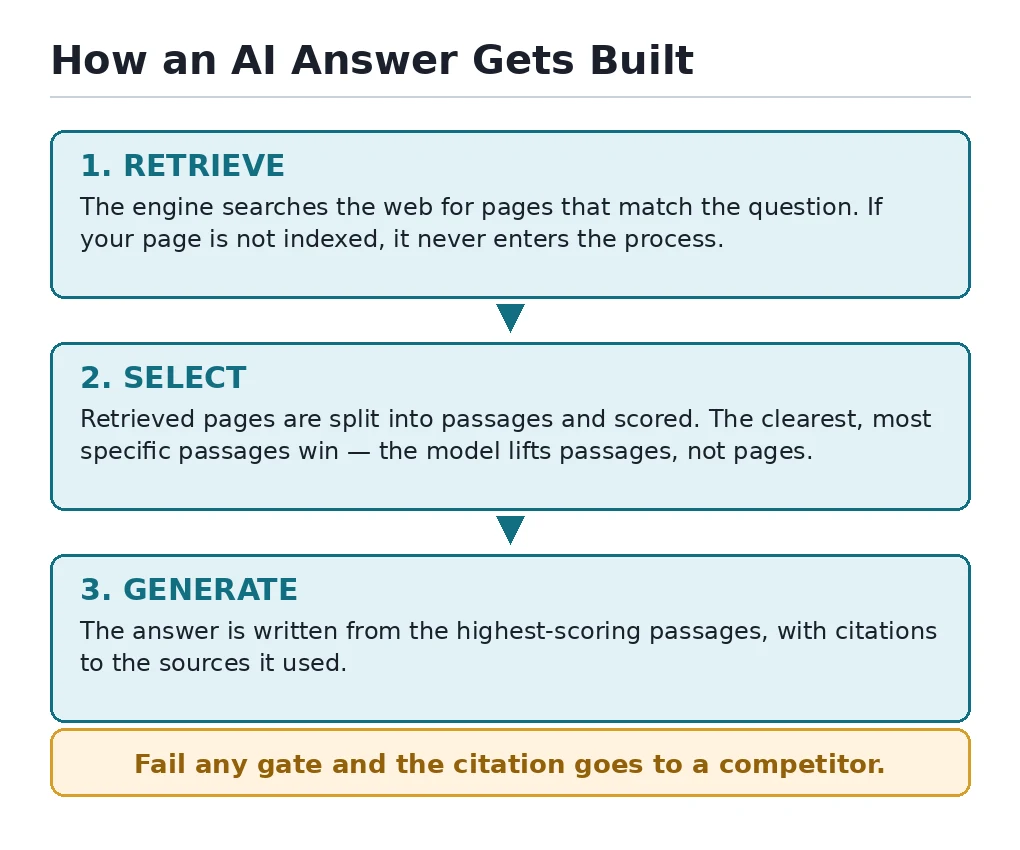
The short answer is three gates and five moves. An AI answer is built in three steps: the engine retrieves a set of pages, it selects the passages that answer the question, and it writes an answer with citations to the sources it used. A brand can be eliminated at any of the three steps: if it is not retrieved, it does not exist; if it is retrieved but its passages cannot be lifted cleanly, it is not selected; if it is selected but another source says the same thing more precisely, the citation goes to the competitor.
The five moves follow the gates. First, let the right crawlers in, so the engines can fetch your pages at all. Second, publish pages that answer real buyer questions directly, in passages a machine can lift whole. Third, make your business a recognizable entity, with the same name, description and facts everywhere. Fourth, earn mentions on the third-party sources the engines already trust, because a citation from someone else counts for more than a claim on your own site. Fifth, measure citations against a fixed set of prompts, so you know what is working instead of guessing.
None of the five moves is a trick, and none of them can be bought: there is no ad product that buys a citation inside an AI answer. What follows is each move in order, engine by engine, with the numbers the research actually supports and the settings that quietly take a site out of the running.
The stakes are worth naming, because they explain why a citation matters more than a ranking. Ahrefs measured a 34.5% drop in clicks to top-ranking pages when an AI Overview appears, and up to 58% in its larger late-2025 follow-up. Pew found that only 1% of users click a source cited in an AI summary. Read together, those two numbers say the same thing: when the answer appears above the results, most people never click through to anyone — and the few who do click go to the sources named in the answer. A citation is therefore not a vanity metric. It is the click itself, for the growing share of searches that never produce a click on a blue link.
GEO stands for generative engine optimization: the practice of making your content easy for large language models — ChatGPT, Perplexity, Google Gemini, Claude, Microsoft Copilot — to find, trust and cite when they write an answer. The term comes from a 2024 academic paper by researchers from Princeton, Georgia Tech, IIT Delhi and the Allen Institute for AI, and it has stuck because it names a real job: being the source the AI trusts when it builds an answer.
AEO stands for answer engine optimization: the older practice of structuring content so it can be used as the direct answer to a question — in featured snippets, People Also Ask boxes, voice results and now AI Overviews. The difference is the unit: AEO optimizes at the level of one short answer to one question, while GEO optimizes the whole brand — the pages, the entity, the mentions — so the model trusts you as a source. In 2027 you want both, because the same page can win the answer box and the citation inside it.
Traditional SEO is the foundation under both, and anyone telling you GEO replaces it is selling something. SEO gets your pages crawled, indexed and ranked; AEO makes your answers extractable; GEO makes your brand citable. If the words SEO, GEO and AEO are new to you, our guide on what is SEO explains the foundation first, and our GEO vs SEO vs AEO comparison explains how the three relate, side by side. The three questions to keep apart are simple: SEO asks whether you rank, AEO asks whether you own the direct answer, and GEO asks whether the AI cites you as a trusted source.
AEO is the older of the two terms, and its history explains why it works. It began with featured snippets — the single box Google has shown above the results for years — and with voice assistants, which can only read one answer aloud. The habit it taught is the same one GEO needs: one question, one direct answer, in words the asker would use. What changed is the surface. A featured snippet shows one source; a generative answer synthesizes several, and the sources it names are the ones whose passages were clearest. The page that wins the snippet and the page that wins the citation are usually the same page, written the same way.
Every AI answer, on every engine, is built the same way, in three steps. First, retrieval: the system searches the web — or its own index — for pages that match the question. ChatGPT searches through a Bing-backed index, Gemini through Google’s index, Perplexity through its own index plus live search. If your page is not indexed, or does not match the question, it never enters the process at all.
Second, selection: the retrieved pages are split into passages and scored against the question. Passages that stand alone, say one thing clearly and carry a specific fact win here. A paragraph that needs the three paragraphs around it to make sense will not be selected, because the model lifts passages, not pages. Third, generation: the model writes an answer from the highest-scoring passages and attaches citations to the sources it used.
The evidence for what wins at the selection step is unusually strong for this field, because it starts with a peer-reviewed study. In the Princeton GEO study, researchers tested nine content changes on a benchmark of 10,000 queries and found that the winning tactics raised visibility in generative answers by up to 40% — and the winners were the ones that make a text more verifiable: adding statistics, citing sources and including expert quotes. Fluent writing helped too, but the verifiable material did the most work.
The second layer of evidence is what the engines actually cite in production, and the work starts with the questions your buyers ask. The list of prompts your buyers use is the starting point: our guide on how to do keyword research walks through finding the searches customers actually use, and grouping searches so each page targets one clear intent is the same discipline as keyword clustering — the point is not the biggest keyword list, it is intent. Our guide on what to do after keyword research turns that list into a plan, step by step — the research is not the deliverable, the map is, and the map for AI search has one more column: the prompt each page is meant to be cited for.
The third layer of evidence is scale: how often each source actually gets cited. An analysis of 200 million prompts found that even the most-cited domain rarely exceeds 5% of total citations on any platform — the other 95% is spread across thousands of domains, which means the realistic goal is not to dominate the citations but to be in them, consistently, for the prompts your buyers ask. A controlled study of 252,000 trials across six large language models found the same pattern from the other side: topical relevance and list position produced the strongest effects on which source received the first citation, with pricing clarity and recency showing consistent effects too. And placement inside the page matters: 44% of all LLM citations come from the first 30% of a page’s content, according to Seer Interactive’s analysis. The answer goes first, the evidence goes with it, and the detail goes below.
Google is the most direct of all the engine owners about what it takes to appear in its AI features, and its answer is shorter than most vendors would like. To be shown as a supporting link in AI Overviews or AI Mode, a page must be indexed and eligible to be shown in Google Search with a snippet. Google’s AI features documentation states it plainly: there are no additional technical requirements, and no special optimization is required. You do not need to create new machine-readable files, AI text files or special schema to appear in these features, and there is no separate application, file or setting to switch on.
That does not mean there is nothing to do — it means the work is normal search work. The technical SEO work behind crawlability, indexation, speed and mobile rendering is the same work that decides whether a page can be retrieved at all, and a page that cannot be crawled cannot be cited, whatever its content says. Our guide on how to do an SEO audit separates technical problems from content and authority ones — the audit tells you which half of the work your site needs first.
What Google does say moves the needle is the content itself: creating content that people find unique, compelling and useful will likely influence a site’s presence in generative AI search. That is the same test as ever, applied to a new surface: a page with first-hand experience, original data, real examples and a clear viewpoint is the page the model can quote with confidence. AI Overviews and AI Mode may use different models, so the links they show will vary, and an Overview only appears when Google’s systems decide it adds something to the classic results. The practical consequence is that you optimize the page, not the feature: indexable, answer-first, well linked, with nothing on it that says noindex or nosnippet. The Search Console report for generative AI performance, rolled out to all sites on 31 August 2026, shows how often links to your site appeared in AI Overviews and AI Mode — the first place to look when you want to know whether the work is landing.
ChatGPT is the largest single AI answer surface, with more than 800 million weekly users, and it is also the engine with the clearest crawler rules — which is why it is the best place to start. OpenAI documents three separate agents, and they are not aliases: the job matters before you touch robots.txt.
OAI-SearchBot is the crawler that surfaces websites in ChatGPT’s search features. OpenAI says sites that opt out of it will not be shown in ChatGPT search answers, and its publishers’ guidance is blunter still: for your content to be included in summaries and snippets, do not block OAI-SearchBot. GPTBot is the crawler for training future models — a separate switch. You can allow search and refuse training, or allow both; the settings are independent, so staying citable does not mean giving your content to training. ChatGPT-User fetches a page when a person asks ChatGPT about it, and it plays no part in search inclusion. OpenAI’s crawler documentation names all three, and the check takes a minute: open your robots.txt, look for the OAI-SearchBot group, and confirm it allows the pages you want cited.
Once the door is open, the selection step decides. Ahrefs found that ChatGPT pulls in dozens of URLs for a single query and ends up citing about half of them, and that 88% of the URLs it cites come straight from its search index. The title, the snippet and the URL make the first call, before ChatGPT opens the page at all — so a page whose title and first lines answer the question survives the cut, and a page that opens with a slogan does not. One audit of enterprise sites found roughly 80% opened with generic messaging and none were structured for AI citation. The fix is the same habit this whole guide repeats: answer first, in the first lines, in the page’s own words, with the evidence in the same passage.
Test the way the crawler reads the page, not the way you read it. A logged-in chat that answers from training is not ChatGPT Search: if the reply has no sources, you tested the wrong product. Turn search on and ask again, and check the answer for a citation you can point at — a citation you cannot point at in the answer is not a citation. The other check is the server: after a robots.txt change, search the access logs for OAI-SearchBot visits after a day. No fetch means the door is still closed, an IP range is blocked, or the change has not propagated — a search-side robots.txt change can take about 24 hours. OpenAI also publishes the search IP ranges, and allowing them is part of the same check. If the crawler cannot fetch the page, the rest of this guide does not apply.
Gemini sits inside Google’s ecosystem, so the Google foundations matter even more here than anywhere else: indexation, relevance and authority still gatekeep visibility, because Gemini retrieves from Google’s index. A page that is not indexed, or that Google does not trust, is a page Gemini never sees.
The second thing Gemini rewards is the business behind the page. For local and service queries, a complete Google Business Profile, consistent citations and real reviews feed the trust signals Gemini uses to choose between two similar pages. A business with a full profile, recent photos, answered reviews and the same name, address and phone number everywhere is a business a model can describe with confidence. Our guide on how to rank higher on Google Maps covers the map pack in detail — and a service page that ranks while the profile does not is a job half done.
The third is structure: clear, factual content that Google can parse confidently, with structured data that names the business, the service and the author. Gemini answers are often built from the same passages that feed AI Overviews, so a page written to be cited in one is written to be cited in the other. The practical order for Gemini is therefore the Google order: indexable first, answer-first second, entity third, and the profile kept current all year round.
Perplexity is the most citation-transparent of the three engines: it shows its sources prominently on every answer, and it rewards pages that answer precisely. That transparency makes it the easiest engine to learn from — open an answer in your market, read the sources it cites, and you can see exactly what kind of page wins.
The rules are the same ones as everywhere else, applied more strictly. Write concise, factual sections that answer a question in one paragraph, because Perplexity lifts passages, not pages. Use descriptive headings that match the question wording, so the passage and the question line up. Cite your own sources and show your method for data claims, because a claim with a source is a claim the model can trust. And update pages regularly: Perplexity favors fresh, current answers for topics that change.
Access is controlled by its own crawlers. PerplexityBot builds the search index, and Perplexity-User fetches pages on behalf of users asking questions. Perplexity’s bot documentation names both, and the check is the same as for ChatGPT: open robots.txt, confirm PerplexityBot is allowed on the pages you want cited, and check the server logs for its visits after a day. A page PerplexityBot has never fetched is a page it cannot cite.
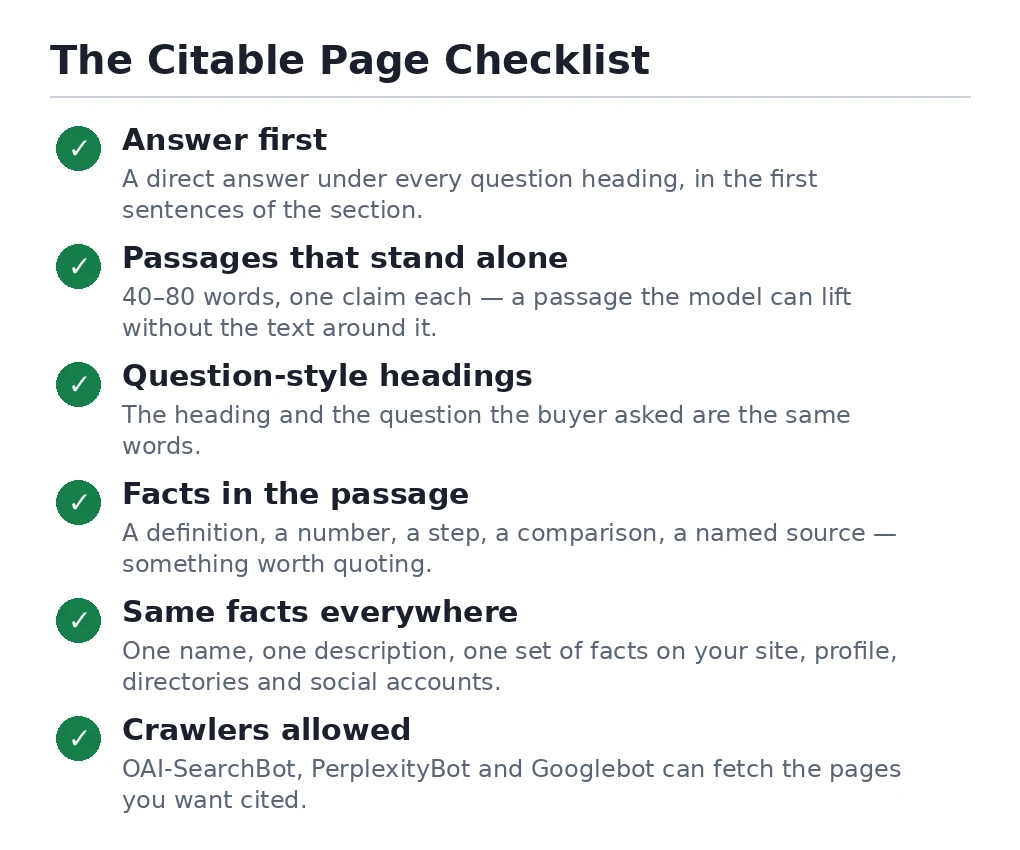
The unit of citation is not the page — it is the passage. ChatGPT, Gemini and Perplexity all lift single passages, usually about 40 to 80 words, and a passage that stands alone wins over a paragraph that needs the three around it to make sense. The craft of a citable page is therefore the craft of writing passages that survive being lifted: one claim, one number or one step, with the evidence in the same passage.
The structure that does this has four habits. First, a direct answer under every question heading, in the first sentences of the section, not buried in a story. Second, question-style headings, so the heading and the question the buyer asked are the same words. Third, short, self-contained paragraphs — one idea each, with the entity, the action, the condition and the evidence in the same place. Fourth, the facts that make a passage quotable: a definition, a number, a step, a comparison, a named source. Vague claims are never cited, because there is nothing in them to quote.
Google’s guidance on creating helpful content rewards pages written for people, not for rankings — which, for a citable page, is the same test as ever: would a reader find anything on this page that is actually useful to them, or is it a page that only exists to hold a keyword? The guidance also asks publishers to evaluate content in terms of who wrote it, how it was made, and why — and a page that shows real experience, with real examples and real numbers, passes that test. Schema helps machines identify what the page is — Organization, Article, FAQ where relevant — but no single schema type creates a citation on demand. The passage is the product; everything else is packaging.
A worked example makes the habit concrete. A weak passage says: “We offer high-quality SEO services that help businesses grow online with our expert team and proven strategies.” There is nothing in it to quote — no claim, no number, no step, no name. A citable passage says: “A full on-page service does six jobs on every page that matters: it maps each page to one search and one intent, it writes the title and meta description, it structures the headings, it deepens the content, it fixes URLs, images and internal links, and it adds schema.” The second passage can be lifted whole into an answer, because it names the six jobs in one place. Every section of a citable page should pass the same test: read the passage alone, out of context, and ask whether it still says something true and specific. If it does not, it is not a passage yet — it is a slogan, and slogans are never cited.
A model cannot cite a business it cannot recognize, and recognition is built on consistency. Write one canonical brand description — 25 to 40 words covering who you are, what you do, who it is for, and where you operate — and reuse it verbatim on your website, your Google Business Profile, your social profiles, your directories and your press materials. The same business name, the same description, the same set of facts, everywhere. A model that sees three different descriptions of the same business in three places trusts none of them.
The same rule applies to the facts. The founding year, the headquarters, the services, the prices, the team — every fact a model might state about you should agree across every source it can read. A price on your site that disagrees with a price on a directory is a fact the model will not state, because it cannot tell which one is true. This is the unglamorous half of GEO: not a file or a plugin, but a dozen small consistencies, kept current.
The payoff is that the entity work compounds. Every mention, review and listing that repeats the same facts strengthens the same entity, and a strong entity is cited more often and more accurately. The work is also the cheapest in this guide: an afternoon to write the canonical description, an hour a month to check that nothing has drifted. Start with the pages you control — the site, the profile, the social accounts — and then fix the directories one at a time.
Here is what a canonical description looks like in practice, using this agency as the example: “Onyx Growth Labs is a full-service digital growth agency founded in 2008, offering SEO, AEO and AI search optimization, web development and digital marketing for clients worldwide from Abbottabad, Pakistan.” One sentence, 40 words, and every fact in it — the name, the founding year, the services, the markets, the place — is the same fact the site, the profiles and the directories state. A model that reads that sentence in five places has no reason to doubt it, and a model that reads five different versions has every reason to. Write yours the same way: one sentence, only facts you can defend, and then copy it verbatim everywhere the business is described.
The strongest citation signal in this whole guide does not live on your website at all. Research from Superlines found that brands are about 6.5 times more likely to be cited through third-party sources — publications, reviews, forums — than through their own website. The large citation studies agree on where those citations come from: Reddit, YouTube, LinkedIn and Wikipedia dominate the top of the cited sources, followed by editorial outlets. These are platforms where a brand can be present but which it does not control, and that is exactly why the engines trust them.
The work follows from that. Earn honest coverage on the sources the engines already read: reviews on the platforms your buyers check, answers in the communities where your buyers ask, mentions in the publications your buyers trust. A review profile with real, recent reviews is a citation asset; a forum answer that solves a real problem is a citation asset; a comparison page on an independent site is a citation asset. None of them can be bought as a citation — a paid placement that reads like an ad is ignored by the same systems that reward an honest mention.
Each platform rewards a different kind of presence. Reddit rewards clear question-and-answer threads in plain language, with balanced opinions rather than marketing copy — and the most-cited Reddit content follows exactly that pattern. YouTube rewards the video that answers the question on camera, with the title and description written the way a buyer would ask. LinkedIn rewards the post that states a position with evidence, from a real person with a real history. Wikipedia rewards nothing you can do directly — it cites independent, reliable coverage — which is why a brand with no independent coverage cannot be cited there, and why earning that coverage is a longer game than any single page. The common thread is that all four are places where real people ask real questions, and the brands that answer honestly are the brands the models quote.
The link work belongs here too, because links and mentions are the same currency with different names. Our guide to what is link building explains what a real link is and what a bought one looks like, and our guide to off-page SEO services explains what real off-page work is and what the bulk packages are not — the short version is that a real link survives being looked at. The authority half of GEO is therefore the authority half of SEO: earn the mentions, and the citations follow. One more calibration belongs here: an analysis of 200 million prompts found that even the most-cited domain rarely exceeds 5% of total citations on any platform. The other 95% is spread across thousands of domains, which means the goal is not to dominate the citations — it is to be in them, consistently, for the prompts your buyers actually ask.
Measure before you optimize, and measure the same way every month. The method is a fixed prompt panel: write down 20 to 30 prompts your buyers actually ask — the questions from your sales calls, your support inbox and your keyword map — and run the same prompts through ChatGPT, Gemini and Perplexity once a month, recording which sources each answer cites. A panel that changes every month measures nothing; a panel that stays fixed shows movement. Our guide to how to track AI visibility shows the checks we run on the AI side of search — the citations, the brand mentions, the answers that name you — and our guide to AI visibility tracking tools covers the tools that automate the same checks, while our post on how we rank in AI overviews shows the same discipline applied to Google’s own surfaces.
The second measure is the traffic the citations bring. Watch AI referrals in your analytics, and watch the Search Console report for generative AI performance, which shows how often links to your site appeared in AI Overviews and AI Mode. Google’s guidance on AI-generated content says what matters is whether the content is helpful and accurate, not how it was produced — the same test as ever: did the page help the person who searched? The reporting follows the same clock as the rest of the site: our guide to the SEO monthly report generator shows what a good monthly report looks like — live URLs you can click, numbers you can read, one sentence per change.
The two free reports deserve a sentence each, because they are the only numbers that come from the engines themselves. In Search Console, the generative AI performance report shows how often links to your site appeared in AI Overviews and AI Mode, and it sits beside the ordinary Performance report, so the same clicks can be compared month to month. In analytics, AI referrals arrive as sessions from the chat platforms themselves, and a simple segment that groups them shows whether cited answers are bringing visitors, not just mentions. A citation that brings no visitors is still worth having, because the buyer may call without clicking, but a citation that brings visitors you can count is the proof the work is paying.
What does it cost? The prompt panel costs nothing but an hour a month, and the Search Console report is free. Paid tracking tools exist — the named ones in this field include Peec, Profound and BrightEdge — but buy the tool only after the free panel shows you what to track, not before. The work itself is priced like any SEO work: our guide on how much SEO costs covers the five factors in detail — scope, competition, site size and condition, who does it, and where they are — and the GEO version is simple: more prompts, more engines, more markets, more cost. If you hire help, vet it the same way as any provider: our guide on how to choose an SEO agency covers the same kind of vetting, fifteen questions, a written scope, and no promises you cannot check.
How long does it take? The access checks can be live in a day, and a newly citable page can appear in an answer within weeks of being fetched. But the entity and the mentions take months, because trust is built one mention at a time, and a model that has never seen your brand cannot cite it. Give the work ninety days, not nine, and judge it on the panel: more prompts naming you this month than last, in the same engines, for the same questions.
Getting cited by AI is not a separate discipline with secret tricks. It is SEO done for a reader that is now a language model with a search tool: retrievable pages, quotable passages, a recognizable entity, honest third-party mentions, and a fixed panel that shows whether any of it is working. Let the right crawlers in, answer first, keep your facts consistent everywhere, earn the mentions you cannot buy, and give the work ninety days to show movement.
Our agency runs SEO the same way we run everything else — with the audit first, a written scope second, and the earned links third. Our content strategy service plans the topics and clusters, our link building services earn the authority, and our local SEO services handle the map pack and reviews for the offices and locations that need them. We also run full SEO audits of our own, with the same fix-first order this guide describes, and our white-label SEO services deliver the same work under your agency’s brand. The full plans are published on the site, and if you want to talk through your situation first, book a free consultation and we will tell you honestly whether you need us at all. You can also see what our work has delivered on our results page. Our plans start at $60 a month, with Small Business Starter plans at $60, $150, or $399 a month, Growth at $899, and Scale at $1,799 — you can see the plans and prices on our pricing page. The buyer already asks the machine now. Answer it in one passage — and be the source it names.
GEO, or generative engine optimization, is the practice of making your content easy for large language models such as ChatGPT, Gemini and Perplexity to find, trust and cite when they write an answer. It builds on ordinary SEO: the pages must be crawled and indexed first, and then structured so the model can lift a clear passage and name your brand as the source.
AEO, answer engine optimization, is about owning the direct answer to one question — in featured snippets, People Also Ask boxes, voice results and AI Overviews. GEO is about being the source the AI trusts when it builds a whole answer, across the pages, the entity and the mentions. In 2027 you want both, because the same page can win the answer box and the citation inside it.
Three steps in order. First, allow OAI-SearchBot in robots.txt — OpenAI says sites that opt out will not be shown in ChatGPT search answers — and keep GPTBot, the training crawler, on a separate setting. Second, publish pages that answer real buyer questions directly, with the answer in the first lines and the evidence in the same passage. Third, measure with a fixed set of prompts run monthly, so you know which sources ChatGPT cites for your market.
No. Google says there are no additional technical requirements to appear in AI Overviews or AI Mode, and no special optimization is required — no new machine-readable files, no AI text files, no special schema. The page must be indexed and eligible to be shown with a snippet. The work is ordinary search work: crawlable, answer-first, well linked, with nothing on the page that says noindex or nosnippet.
Perplexity lifts precise passages, so the usual reasons are that your page was never fetched by PerplexityBot, that the answer is buried instead of stated in one paragraph, or that a competitor states the same fact more precisely with a source. Open an answer in your market, read the sources it cites, and compare them with your page: the gap is usually the passage, the freshness, or the access.
The access checks can be live in a day, and a newly citable page can appear in an answer within weeks of being fetched. The entity work and the mentions take months, because trust is built one mention at a time. Give the work ninety days, not nine, and judge it on a fixed prompt panel: more prompts naming you this month than last, in the same engines, for the same questions.
No. There is no ad product that buys a citation inside an AI answer, on any engine. Paid placements, sponsored mentions and bought links are ignored by the same systems that reward an honest mention on a source the engines already trust. The only route is the work in this guide: retrievable pages, quotable passages, a consistent entity, and earned mentions.
Yes. We do GEO and AEO work the same way we run everything else — with the audit first, a written scope second, and the earned links third — the citable pages, the entity work, the mentions, and a monthly report you can click through. Our plans start at $60 a month: Small Business Starter at $60, $150, or $399, Growth at $899, and Scale at $1,799. Talk to us first and we will tell you honestly whether you need us at all.

Muhammad Haris is the Founder of Onyx Growth Labs — an SEO specialist, content writer and SEO team lead. He writes the agency's guides on SEO, AI search optimisation, GEO and AEO, technical SEO, local SEO, Google Business Profile optimisation, link building and content strategy. Based in Abbottabad, Pakistan, he helps businesses worldwide get found on Google and in AI search answers.
A growing share of search no longer ends on a results page. People ask a question and receive a synthesized answer —…
Read articleSearch is changing. More and more people now get their answers directly from AI tools instead of clicking through a list of…
Read articleEveryone wants to be visible in AI answers. Almost nobody measures it. Businesses invest in "AI search optimization" and then judge success…
Read article


Leave a Reply