0:00
0:00
Speed
 By Muhammad Haris · November 14, 2026 · Last updated: November 19, 2026 · 6 min read
If you have been hearing the term GEO everywhere lately and wondering what is geo, exactly, you are not alone. GEO stands for generative engine optimisation: making your content easy for AI-powered answer engines — AI Overviews, chatbots, and other generative answers — to find, understand, and cite. It is not a replacement for SEO, nor a trick for gaming AI answers — just content and clarity habits that help your expertise show up where people now get answers without clicking a traditional result.
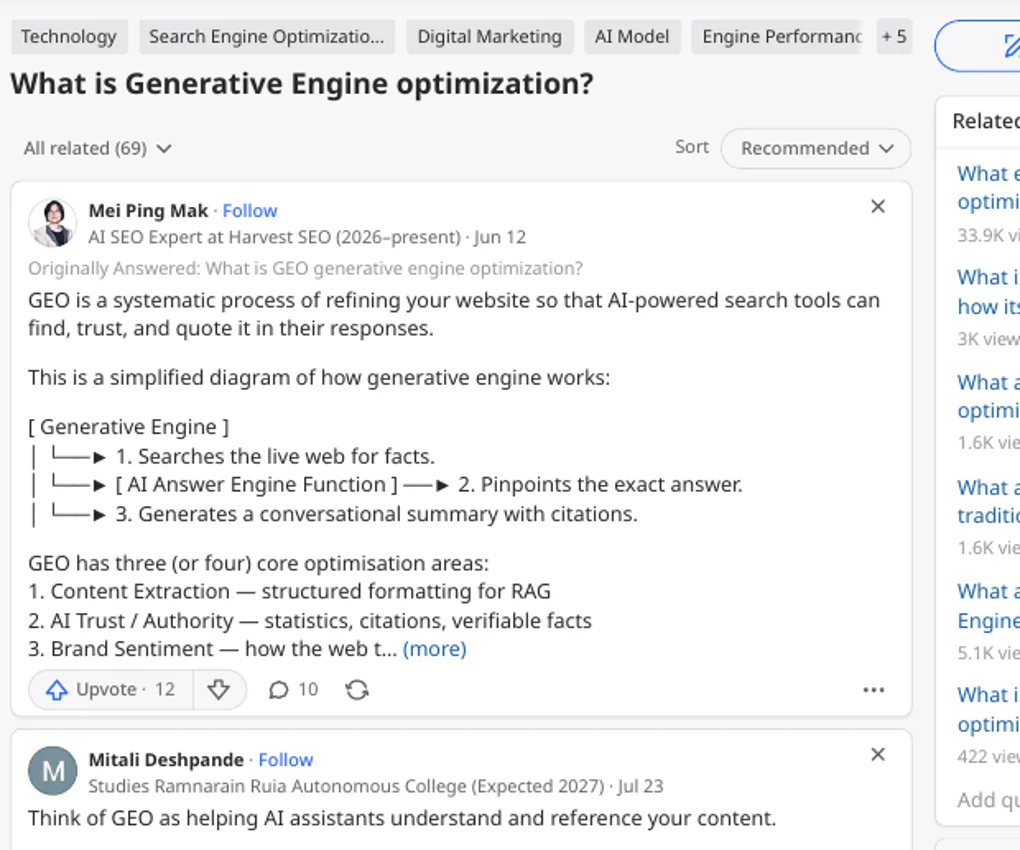
Search used to be a list of links: you typed a question, Google showed ten blue links, and you picked one. Generative answers changed that: for many questions, the engine or chatbot now writes an answer itself from web pages — sometimes with citations, sometimes without.
GEO is the discipline of making your pages useful to that process. It asks a different question from classic SEO. Classic SEO asks: how do I rank this page? GEO asks: when an AI system answers a question my customers ask, will it find my page, understand what it says, trust it, and cite it?
That shift matters because the answer a person sees may never become a visit to your site. If your content is the source behind an answer, you still gain visibility and authority — but only if the system can parse it.
GEO is not a way to force your way into AI answers: nobody can guarantee an AI Overview citation, and any agency promising one is selling something it does not control.
GEO is also not a separate channel you can buy in isolation: it builds on good SEO’s foundations — crawlable site, fast pages, clear structure, genuinely useful content — and thin, broken sites do not become AI favourites just because the work was relabelled.
And GEO is not local targeting: the letters also appear in “geographic” contexts. Here, GEO means generative engine optimisation only — AI answers, not map results.
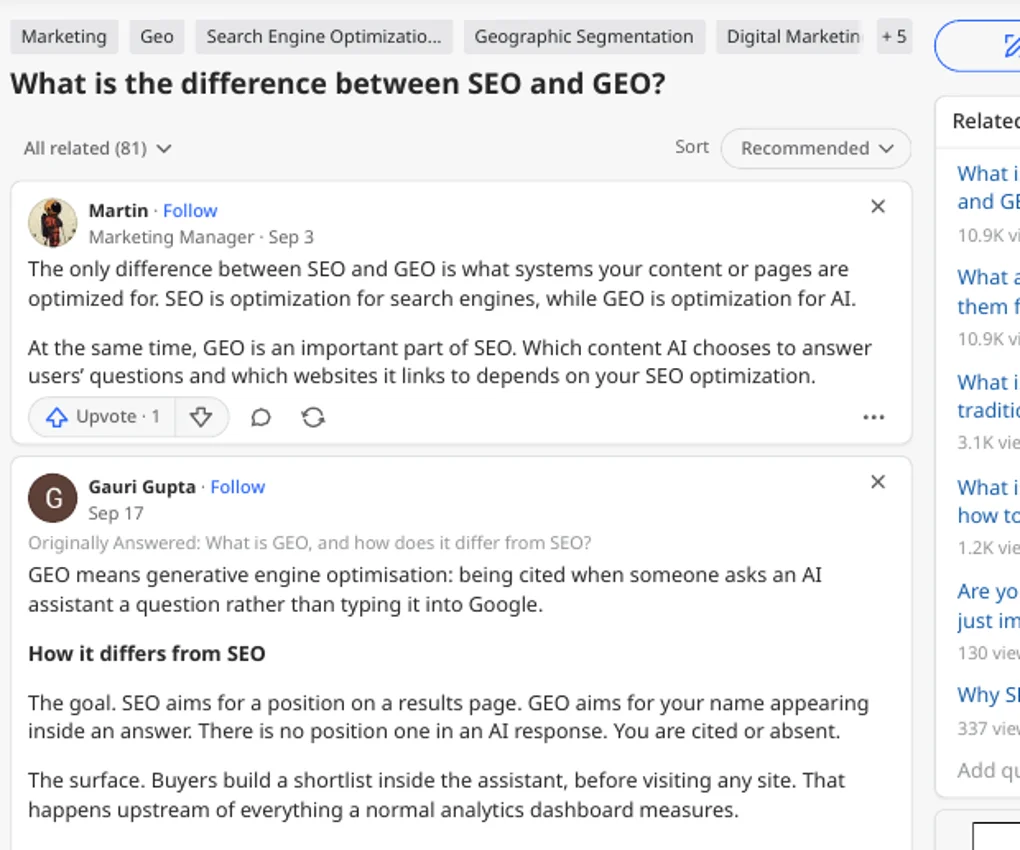
Traditional SEO optimises for a ranked list, where success looks like a position and the user must still choose your result, click it, and read your page.
GEO optimises for being used as a source: a citation, a mention, or your facts in the answer itself. The user may never click through, so the value is brand visibility and trust, not a guaranteed visit.
That changes what good content looks like. A page written only to rank might bury its answer under keyword-stuffed introduction; a page written for AI answers puts the direct answer first, then the evidence. Clear headings and short factual statements help both readers and systems — which is why good GEO usually improves ordinary SEO too.
AEO — answer engine optimisation — is GEO’s older sibling, grown out of featured snippets and voice search: structuring content so a search engine can lift a direct answer. GEO extends that idea to longer, synthesised generative answers.
In practice the two overlap heavily: a page with a clear direct answer, well-organised sections, and supporting detail serves both. The distinction matters mainly so you are not sold the same work twice under two names. Our comparison of GEO vs SEO vs AEO sets out the three side by side, and our guide to what AEO is covers AEO.
No AI provider publishes a complete recipe for how it picks sources, so much of what follows is observed practice, not stated rules — and honest GEO work keeps that distinction visible.
What Google has stated is that AI Overviews are built from web content and link to their sources. Beyond that, the observed pattern is consistent: systems favour pages that state facts plainly, cover a topic thoroughly, and come from visibly expert sources — pages that answer in the first paragraph and support claims with specifics.
Authority matters too: a site with a track record on a topic — real guides, real depth, consistent publishing — is a safer source than a new page with no history. GEO is a long game; cited authority is built over months, not bought in a week.
Start with the answer itself: open with a direct, plain-language answer to the page’s question — one or two sentences a reader (or a system) can lift without guessing. Then support it with reasoning, steps, examples, and exceptions.
Next, structure: descriptive headings that mirror real questions, short paragraphs, and lists where they fit make a page easier to parse. Consistent terms help a system connect your pages to your expertise.
Entity clarity is the quieter part: an AI system needs to know who you are and what you do. State your business name, services, and expertise plainly — not hidden in images or vague marketing language.
Finally, keep the page honest: unsupported claims, invented statistics, and vague superlatives do not help, because systems that check sources will find nothing to check against. Real specifics — named processes, real steps, real limitations — are what make a page citable. Our guide to how we rank in AI Overviews shows how this thinking applies in practice.
Measuring AI visibility is harder than measuring rankings: there is no single dashboard. Combine checks instead: ask your customers’ questions in AI tools and note whether your brand or pages appear, watch for referral traffic from AI platforms, and track branded searches and direct visits, which often rise when AI answers mention you.
Our guide to how to track AI visibility covers this in more detail. Measure trends, not single answers: AI outputs vary between sessions, so one absence proves nothing, while a pattern over weeks shows whether you are gaining ground.
GEO will not replace SEO in 2027, nor your existing marketing: search results still send traffic, and most buying journeys still involve clicks. What GEO adds is presence in the answers themselves — the part traditional rankings do not cover.
Expect gradual results: pages optimised for AI answers may take weeks or months to appear as sources, and citations will come and go as systems update. Judge GEO work by whether your pages are clearer, more complete, and more authoritative, and whether your brand appears more often in the answers your customers see.
The businesses that will do best are not chasing the newest acronym: they already publish genuinely useful content and now shape it so both people and AI systems can use it. That is ordinary good practice — GEO is good SEO, aimed at a new kind of answer.
Q: What is GEO in simple terms?
A: GEO, or generative engine optimisation, makes your content easy for AI answer engines to find, understand, and cite.
Q: Is GEO the same as SEO?
A: No, but it builds on SEO: ranked results and clicks for SEO, citations inside AI answers for GEO — and good GEO usually improves ordinary SEO too.
Q: Is GEO the same as AEO?
A: They overlap but are not identical: AEO targets direct answers in snippets and voice results, GEO longer generative answers — and a well-structured page serves both.
Q: Can anyone guarantee my business will appear in AI Overviews?
A: No: nobody controls which sources an AI system cites, so any guarantee of placement is a red flag. GEO improves your chances; it cannot promise a result.
Q: How long does GEO take to show results?
A: Expect weeks to months: citations depend on your site’s authority and content depth, which build gradually. Measure trends, not single answers.

Muhammad Haris is the Founder of Onyx Growth Labs — an SEO specialist, content writer and SEO team lead. He writes the agency's guides on SEO, AI search optimisation, GEO and AEO, technical SEO, local SEO, Google Business Profile optimisation, link building and content strategy. Based in Abbottabad, Pakistan, he helps businesses worldwide get found on Google and in AI search answers.
If you lead marketing for a large organisation, you have probably discovered that SEO advice written for small businesses does not scale…
Read articleIf you run a small business on a limited marketing budget, the social media vs seo question comes up fast: social posts…
Read articleIf you have started checking whether your business appears in AI answers, you have probably found a new problem: a growing number…
Read article


Leave a Reply